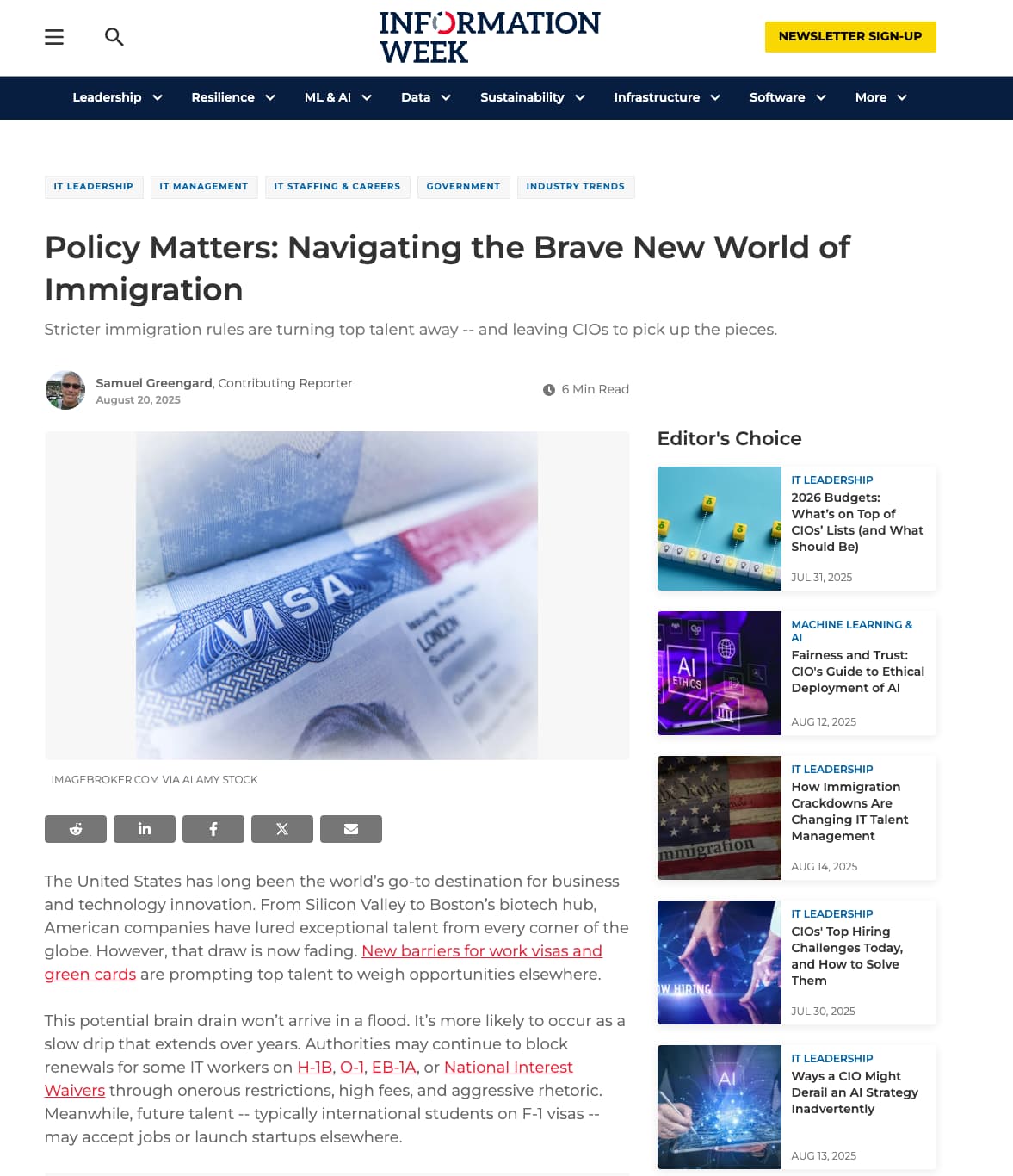
Information Week features Loren Locke discussing EB-1A and National Interest Waiver green card pathways for tech workers.
From the Article
"CIOs can support this by helping them build qualifying case profiles."
Locke Immigration Law's Take
The Information Week piece reframes the EB-1A and NIW conversation from "advanced individuals filing on their own" to something that's increasingly relevant to employers: high-value tech workers whose H-1B route has become unreliable, where the employer has both incentive and ability to support the worker's self-petition. The article quotes Loren's recommendation that CIOs help employees "build qualifying case profiles" — but it's worth being explicit about what that means in practice, because the technical answer matters.
EB-1A and NIW are technically self-petitions: the employer doesn't sponsor and doesn't sign the I-140. But the evidence the petition needs — peer-reviewed publications, conference presentations, original contributions of major significance, judging or peer-review service — is overwhelmingly evidence the employer can either generate or document. CIOs who want to help can: budget conference travel and speaking-slot prep, allocate paid time for peer-review service, fund publication-support resources, and document internal-original-contribution moments (proprietary architectures, novel methodologies) in a form that translates to a USCIS petition. None of this requires changing the legal posture of the case.
The other piece the article touches but doesn't develop: when an employer materially supports a worker's EB-1A or NIW path, the retention payoff is durable. Workers stay through the case (because the case depends on continuing US-based work), through approval (because the green card is now in motion), and beyond approval (because the relational debt is real). Companies that have boosted retention by a third through early green-card support — as one executive in the article describes — aren't doing magic. They're aligning the retention curve with the immigration calendar.
Key Takeaways
- EB-1A and NIW are self-petitions, but employers have substantial leverage to generate the evidence the cases need: publications, conference presence, peer-review service, documented original contributions.
- "Building a qualifying case profile" maps to specific employer actions — conference budgets, paid peer-review time, publication support, internal-contribution documentation.
- These cases are increasingly the practical answer for senior tech workers whose H-1B path has become unreliable.
- Material employer support of EB-1A/NIW filings produces durable retention because the case timeline aligns with the worker's reason to stay.