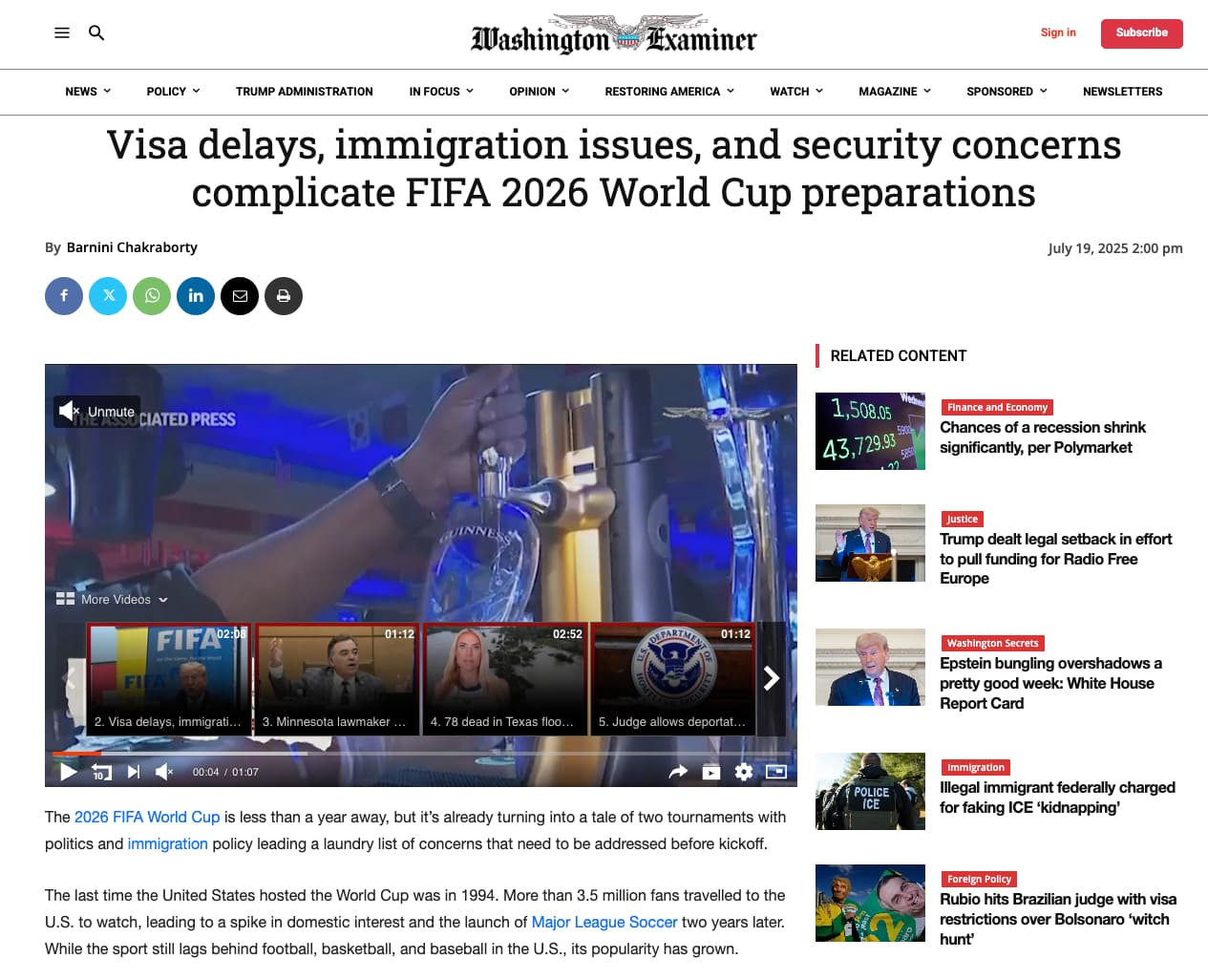
Washington Examiner features Loren Locke discussing immigration implications of the 2026 World Cup.
From the Article
"The United States has announced no such accommodation. Instead, international visitors who don't qualify for ESTA visa waiver travel need to secure visas through our standard process."
"Unfortunately, the wait time for a B1/B2 visitor visa interview is hundreds of days long at some U.S. Consulates and Embassies."
"Since our visa system has a one to two year backlog at some consulates, our government is essentially telling foreign soccer fans they're not welcome."
Locke Immigration Law's Take
The Washington Examiner article puts a number on a question that had been mostly hand-waving: 6.5 million people are expected to travel to the United States for the 2026 World Cup, distributed across 11 host cities, contributing a projected $17.2 billion to US GDP. Against that demand, B1/B2 visitor visa interview wait times at some US consulates are hundreds of days long. As Loren noted in the article, "since our visa system has a one to two year backlog at some consulates, our government is essentially telling foreign soccer fans they're not welcome." This isn't a friction problem the consular network can absorb at the margin. The math doesn't work even if every consulate ran at twice its current pace.
Qatar in 2022 and Russia in 2018 both implemented special accommodation procedures — fan IDs, streamlined entry, fast-track visas — specifically to handle the World Cup demand surge. The United States has announced no such accommodation. The default position is that visitors who don't qualify for ESTA visa-waiver entry need to clear the standard visa pipeline, and the standard pipeline doesn't have the throughput. Visitors from large football markets in Latin America and parts of Asia are precisely the population that doesn't qualify for ESTA — meaning the bottleneck disproportionately affects the fans the tournament was designed to host.
For tournament-related employer-clients (sponsors, broadcasters, vendors, official suppliers needing foreign staff in the US for tournament-period work), the planning question is simpler than it looks: standard B1 visitor visas may not be a reliable path for personnel needed in mid-2026. L-1 transfers, O-1 for individuals with extraordinary credentials, or compressed-timeline B1-in-lieu-of-H1B arrangements are all worth evaluating now. Filing in early-to-mid 2026 against the standard pipeline is filing too late.
Key Takeaways
- 6.5 million visitors expected for the 2026 World Cup across 11 US host cities, projected to contribute $17.2 billion to US GDP.
- B1/B2 visitor visa wait times are currently hundreds of days at some US consulates — the consular network cannot scale to meet World Cup demand within standard processes.
- Qatar (2022) and Russia (2018) implemented World Cup-specific accommodation procedures; the US has announced none.
- Tournament-related employers (sponsors, broadcasters, vendors) should evaluate alternative visa pathways (L-1, O-1, B1-in-lieu) now; filing in early/mid-2026 against standard pipelines is filing too late.