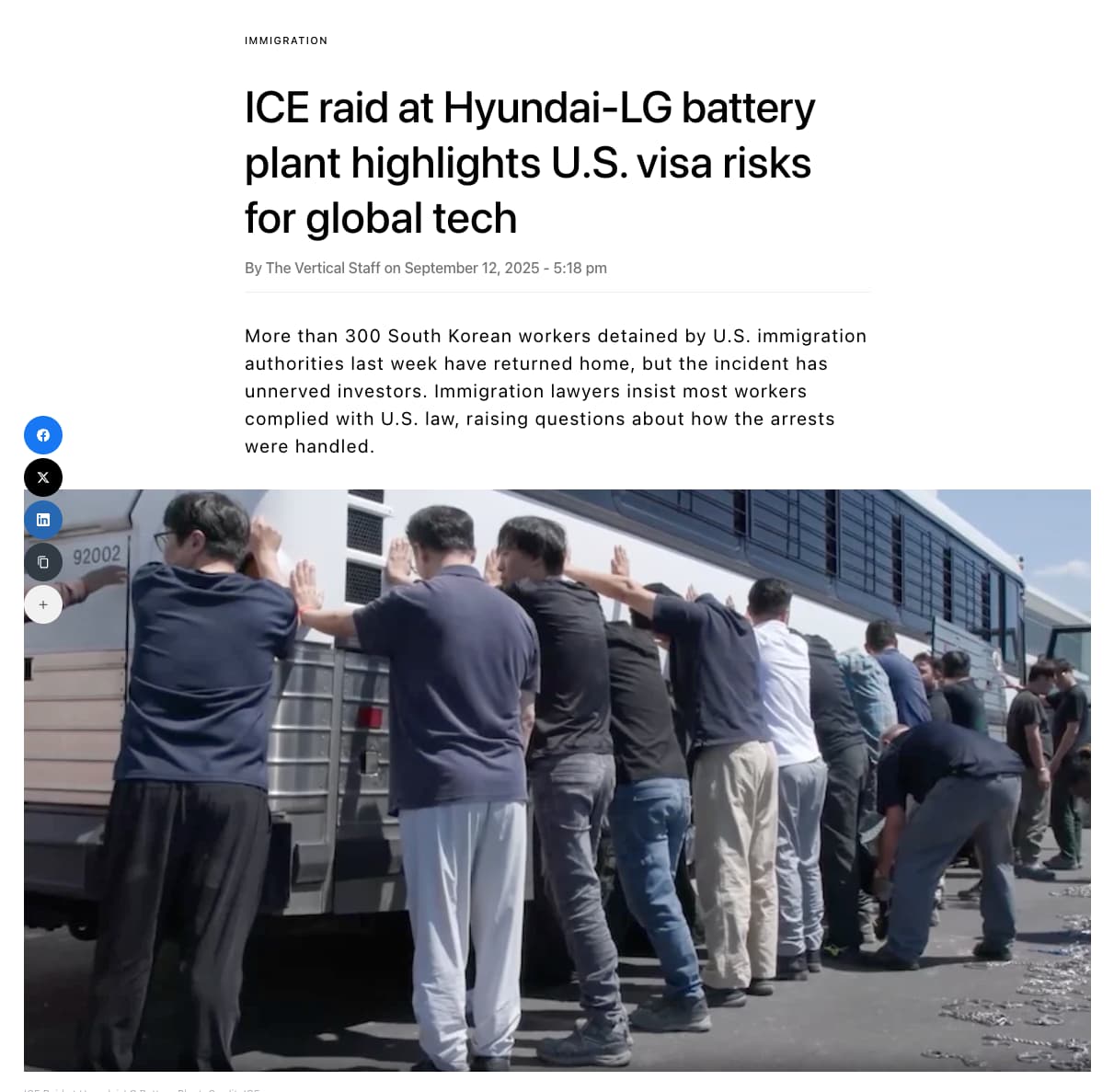
The Vertical quotes Loren Locke regarding the ICE raid at the Hyundai-LG battery manufacturing plant.
From the Article
"They do not need to disclose their travel plans, and it's up to them, together with their employers and legal counsel, to make sure that they perform activities that fall within the bounds of a 'business visitor.'"
"Before this unprecedented huge raid, it would not have been seen as particularly risky to send over workers to perform limited duties as business visitors."
Locke Immigration Law's Take
The Hyundai-LG raid was the largest single-site ICE enforcement action in Department of Homeland Security history — 475 workers detained, predominantly South Korean nationals, at the $4.3 billion Hyundai-LG battery-plant joint venture — part of a broader Hyundai Metaplant site that, at roughly $7.6 billion, ranked among Georgia's largest-ever inbound investments (Hyundai's total expanded Georgia commitment is often cited at about $12.6 billion). The article's central legal question, the one Loren engaged with directly, is whether those workers were operating within the bounds of B-1 business-visitor status (legitimate) or performing work that required formal employment authorization (not legitimate). For most of the past decade, the answer was assumed to be the former, and Loren's framing captures why: "Before this unprecedented huge raid, it would not have been seen as particularly risky to send over workers to perform limited duties as business visitors."
The B-1 boundary is real and well-defined: the regulations explicitly permit a foreign worker to "install, service, or repair commercial or industrial equipment" purchased outside the US, provided the work is performed by employees of the seller, the contract specifies installation/training, and the worker isn't being paid by a US source. South Korean nationals get added flexibility through ESTA visa-waiver entry — 90-day stays without an advance visa application. Many Hyundai-LG detainees almost certainly were doing exactly what the regulations describe; the raid didn't establish that they weren't, but it did establish that being right under the regulations doesn't insulate workers from detention while the determination gets made.
For multinational clients with US installation, training, or commissioning work on the calendar, the planning question we're now hearing weekly is: does the regulatory permission still translate to operational safety? The honest answer is "yes, but the operational risk has gone up materially." Specific mitigations: detailed pre-arrival documentation of the activity (purchase contract, scope of services, employer-of-record), interpreters available on-site, employer legal counsel reachable, and — for high-stakes deployments — pivoting from B-1 to L-1 or H-1B where the activity duration or compensation structure justifies it.
Key Takeaways
- 475 workers detained at the Hyundai-LG battery plant — the largest single-site ICE enforcement action in DHS history — at a $4.3B battery-plant joint venture inside Hyundai's multibillion-dollar Georgia Metaplant.
- B-1 business-visitor status legitimately permits installation/service/repair of foreign-purchased equipment if specific conditions are met; many detainees were likely within those bounds.
- South Korean nationals get added flexibility through ESTA visa-waiver entry (90-day visa-free stays) for legitimate B-1 activities.
- Being legally correct under B-1 regulations no longer insulates workers from detention while the determination gets made — operational risk has shifted even when legal posture hasn't.
- Mitigations for multinationals: pre-arrival documentation of activity scope, on-site interpreters, reachable employer counsel, and pivoting to L-1 or H-1B for high-stakes deployments.