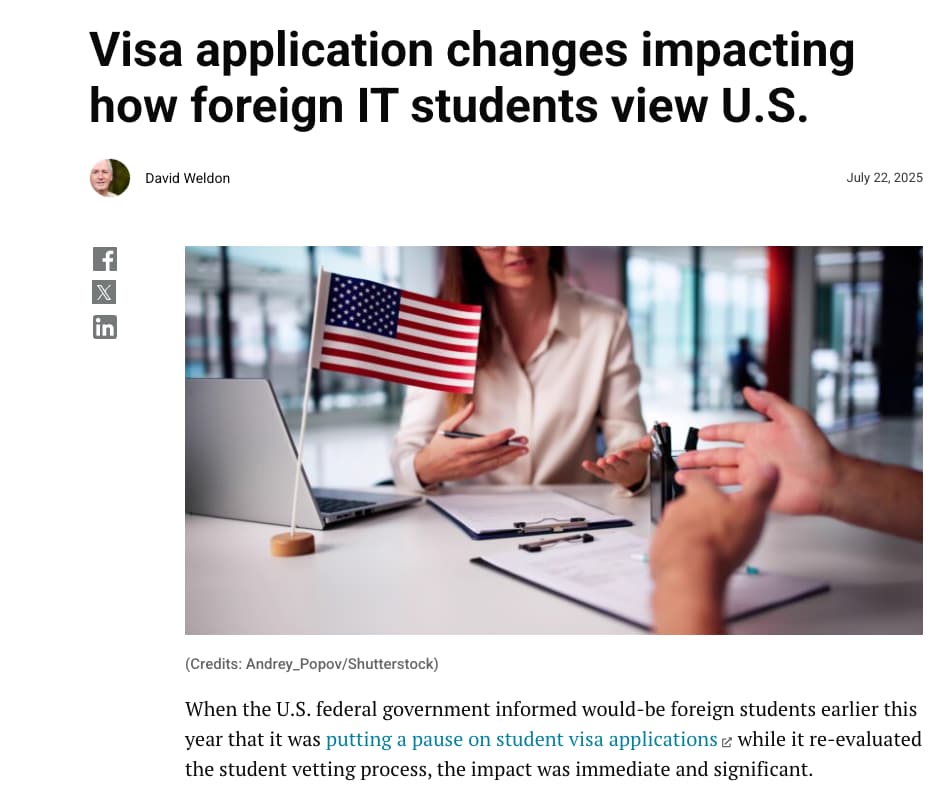
Spiceworks features Loren Locke discussing the significant decline in international student applications to U.S. universities.
From the Article
"I expect the numbers to dip much further for 2025-26, because of the new F, M, and J visa policy."
"A 221(g) refusal puts the visa applicant into an open-ended state of limbo with no clear timeline."
"As long as STEM OPT continues to exist, I think foreign students will continue to have a powerful incentive."
Locke Immigration Law's Take
The Spiceworks piece focuses on one specific procedural mechanism that's reshaped the student-visa landscape this year: the 221(g) refusal. As Loren put it in the article, "A 221(g) refusal puts the visa applicant into an open-ended state of limbo with no clear timeline." For applicants and their universities, that procedural distinction matters enormously — a 221(g) isn't a denial; it's an administrative-processing hold. The applicant hasn't been refused, but they also haven't been issued the visa, and there's no defined endpoint to the hold. Universities and employers planning around expected start dates can't plan against a hold of unknown duration.
The article's headline finding is that international student applications are dropping, and Loren's framing combines two pressures: the F, M, and J visa policy that took effect in late June 2025, and the cumulative chilling effect of how international students are being treated in public discourse. Both drivers compound — a single applicant deciding not to apply is a multi-year revenue loss for the university, and over a cohort scale it becomes a structural shift in where global STEM talent goes for graduate education.
What the article doesn't fully develop: STEM OPT remains the powerful incentive Loren named — three years of post-graduation work authorization for STEM majors. As long as that incentive exists and survives the policy turbulence, the absolute floor on international application numbers stays well above zero. For universities and employers, the planning question is whether to assume the OPT/STEM OPT framework holds (in which case current declines are recoverable) or whether to model a scenario where it doesn't (in which case the entire F-1 → OPT → H-1B → green card pathway needs structural alternatives). Most of our employer-clients are now planning against both scenarios in parallel.
Key Takeaways
- A 221(g) refusal is an administrative-processing hold of indefinite duration, not a denial — but the "open-ended limbo" effect on planning is the same as a denial.
- The June 2025 F/M/J visa policy plus the chilling-effect of public discourse are compounding drivers of declining international student applications.
- STEM OPT (3 years post-graduation work authorization) is the floor on the international applicant pool — as long as it exists, applications won't go to zero.
- Universities and employers are now planning against both scenarios in parallel: STEM OPT survives (current declines recoverable) vs. STEM OPT changes (full pipeline alternatives needed).