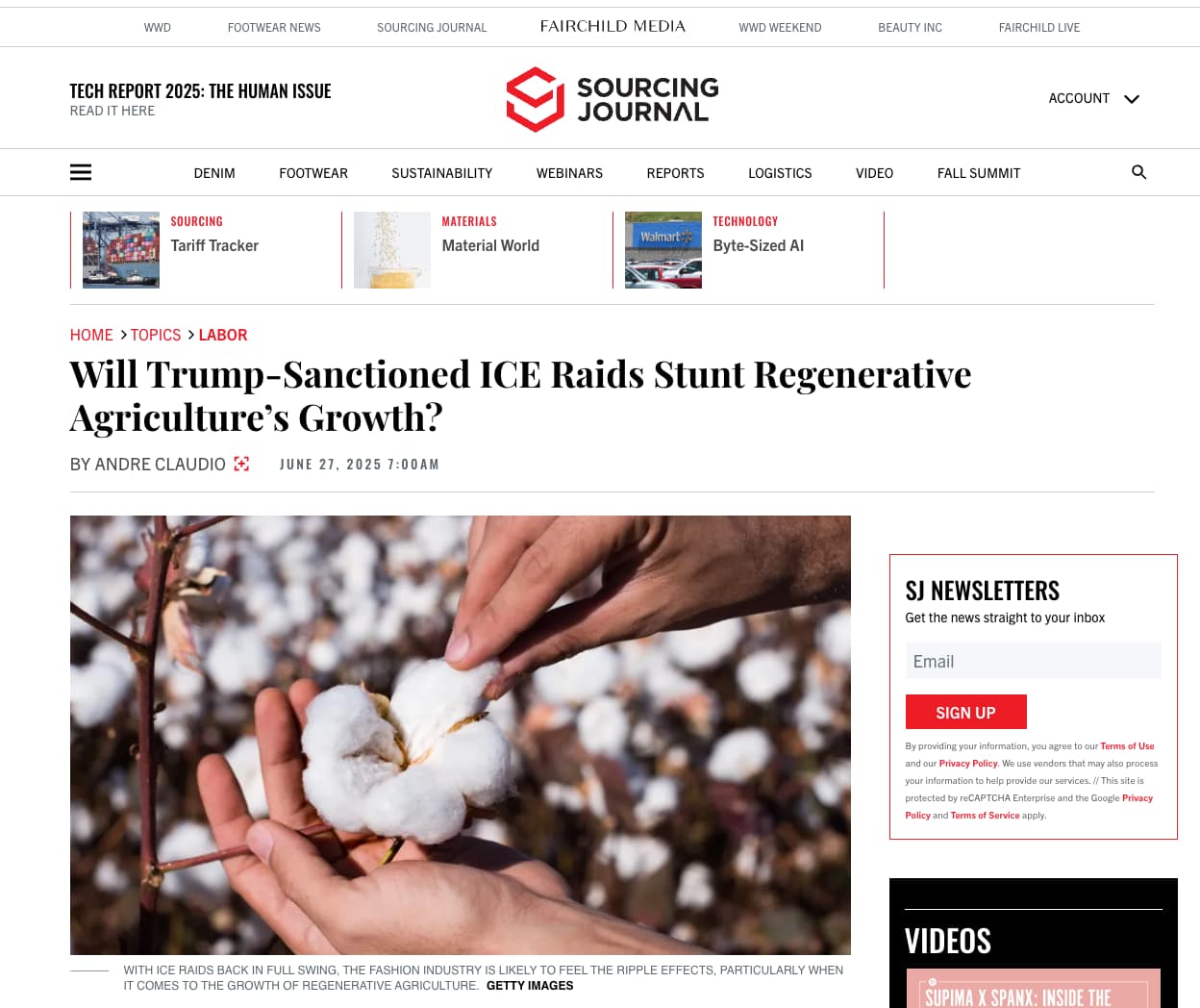
Sourcing Journal quotes Loren Locke on the impact of ICE raids on the regenerative agriculture industry.
From the Article
"We're seeing policy whiplash that's creating operational chaos. This instability makes it impossible for businesses to plan."
"Immigration enforcement actions could drive away experienced farmworkers at particularly devastating points in the cotton season."
Locke Immigration Law's Take
The Sourcing Journal piece grounds the policy-whiplash framing Loren named with the specific industry stakes: roughly 283,000 undocumented immigrants work in US agriculture; Better Cotton, the certification program that includes regenerative practices, accounts for 22% of global cotton production across 22 countries; the H-2A guest-worker visa — the legal alternative for seasonal farm labor — takes up to three months to approve. Cotton harvest timing isn't flexible. As Loren put it, "immigration enforcement actions could drive away experienced farmworkers at particularly devastating points in the cotton season."
The structural mismatch is timing. H-2A is the legal pathway, but the three-month approval lag means a producer who needs workers in August has to file in May. That requires forecasting season-specific labor demand months ahead — feasible for stable operations, brittle for the smaller and more diversified regenerative-agriculture operations the article focuses on. When ICE enforcement removes experienced workers mid-season, the H-2A pathway can't backfill on the timeline the harvest needs. The CNN data the article cites — 75% of those booked into ICE custody between October and May FY2025 had no criminal convictions beyond immigration or traffic offenses, fewer than 10% convicted of serious crimes — explains why agriculture is exposed: the workers being removed aren't a separate-criminal-class population the operations could replace from the open labor market.
For agricultural-employer clients, the planning conversation we're now having centers on three options: forward-loading H-2A applications for the next harvest cycle (filing 4–6 months ahead instead of 3, accepting some over-budgeting), formalizing employment relationships for retention-priority workers via PERM-based EB-3 green cards where the worker's tenure and the role's specifics support it, and evaluating whether mechanization investments that previously didn't pencil now do. None of these solve the current-season exposure, but they materially reduce next-season fragility.
Key Takeaways
- ~283,000 undocumented immigrants work in US agriculture; Better Cotton accounts for 22% of global cotton production across 22 countries.
- The structural mismatch is timing: H-2A guest-worker approvals take up to 3 months, so a producer needing workers in August has to file in May — workable for stable operations, brittle for smaller/diversified regenerative operations.
- 75% of FY2025 ICE detainees (Oct–May) had no convictions beyond immigration/traffic offenses (CNN data) — agriculture is exposed because the workers removed aren't replaceable from the open labor market.
- Forward-loading H-2A applications (filing 4–6 months ahead) reduces next-season fragility but doesn't solve current-season exposure.
- PERM-based EB-3 green-card sponsorship for retention-priority experienced farmworkers is the durable alternative for operations where the worker's tenure justifies it.