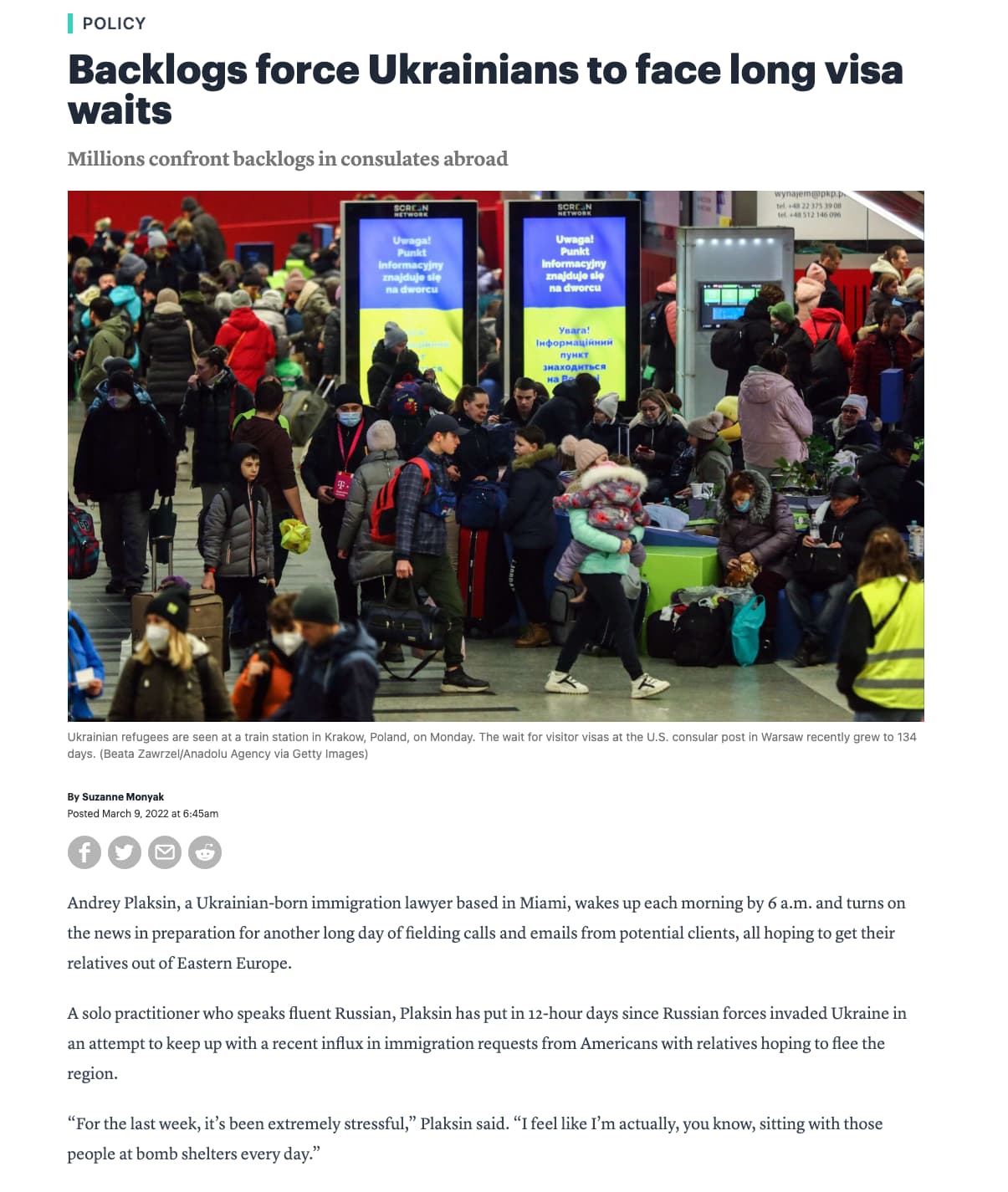
Roll Call features Loren Locke discussing the growing backlogs in U.S. visa processing.
From the Article
"I think the surrounding consulates are willing to absorb extra work, and they'll do it. Is that going to magically give them the capacity to do it as fast as everybody would like? No, because they still have their own backlogs."
Locke Immigration Law's Take
In March 2022, in the immediate aftermath of Russia's invasion of Ukraine, the wait times Loren observed in this Roll Call piece were already structural: Warsaw at 134 days for visitor visas, Budapest at 275 days, Chisinau at 329 days, with about 500,000 cases pending across regional posts. Loren's pragmatic point at the time — that surrounding consulates would absorb extra work but wouldn't magically gain capacity — has aged into a useful frame for thinking about what consular bandwidth actually responds to in a crisis.
What the 2022 backlog showed, in retrospect, is that the consular network has limited surge capacity by design. Posts can extend hours, prioritize humanitarian categories, and reroute green-card processing (the State Department moved Ukrainian green-card cases to Frankfurt that year), but the underlying interview throughput is constrained by interview officer count, language coverage, and physical space. Each of those constraints binds differently in a crisis: the Frankfurt rerouting worked for the green-card population; it couldn't have worked for the visitor-visa population because Frankfurt's own visitor-visa backlog was already long.
For 2026, the throughput math is the same and the gap has widened. The 2022 framing — "the surrounding consulates are willing to absorb extra work, but they have their own backlogs" — still describes how the network responds to demand surges. For the firm's current clients planning around World Cup 2026 demand (covered separately in our Washington Examiner commentary), the lesson from 2022 is that "surrounding consulates" don't solve a category-wide bottleneck. They're a marginal release valve, not a structural fix. Planning has to assume the standard consular pipeline, with whatever wait times that pipeline currently shows.
Key Takeaways
- The 2022 wait times Loren observed (Warsaw 134, Budapest 275, Chisinau 329 days) showed the consular network has limited surge capacity by design.
- Surrounding consulates can absorb marginal extra work but can't close a category-wide bottleneck — they have their own backlogs.
- The 2022 Ukrainian green-card rerouting to Frankfurt worked because Frankfurt's green-card capacity was available; visitor-visa rerouting wouldn't have worked because Frankfurt's visitor backlog was already long.
- For current-day planning (2026 World Cup, post-policy-shift demand), the structural lesson holds: assume the standard consular pipeline, not a "surrounding consulates" release valve.