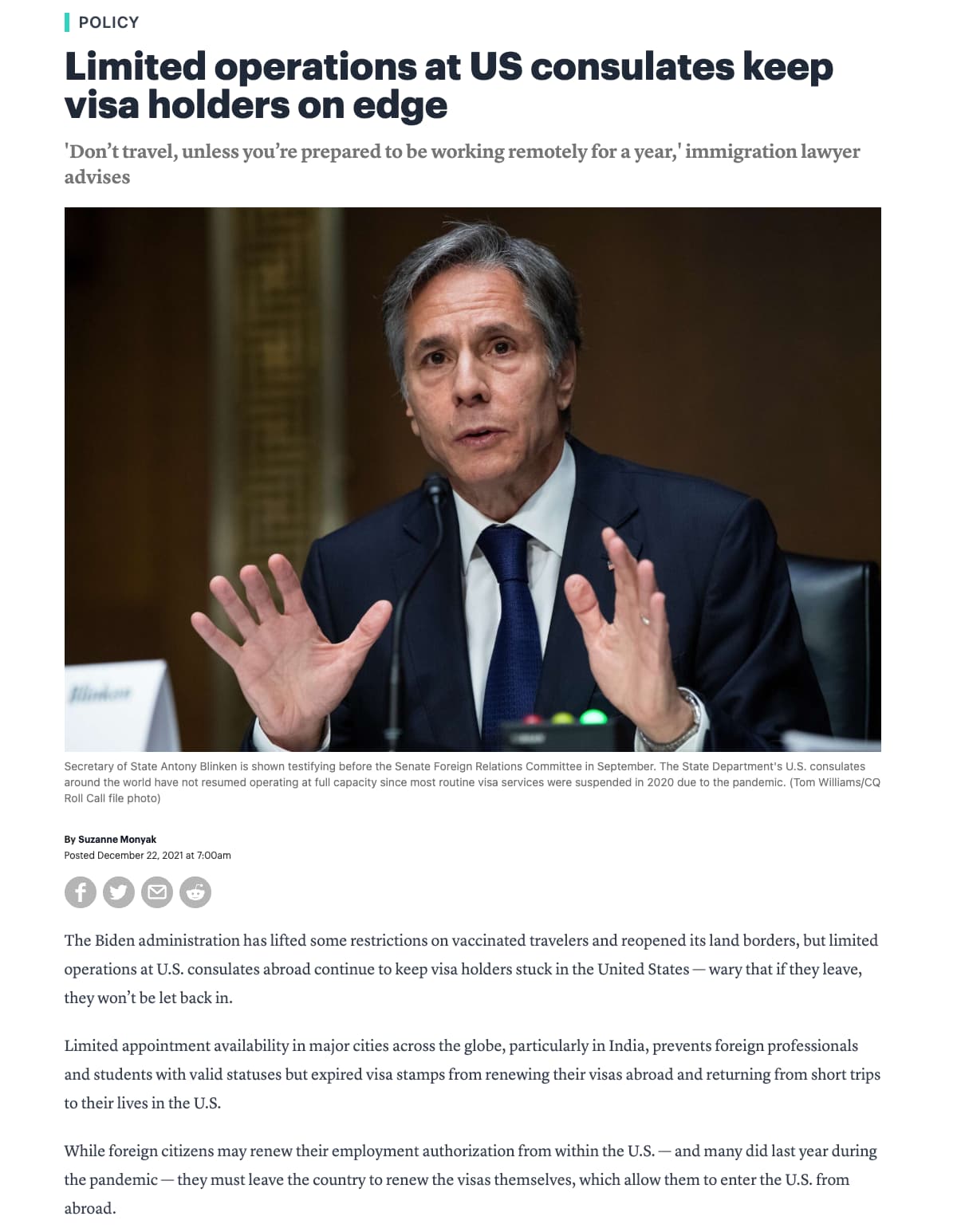
Roll Call quotes Loren Locke on the continued limited operations at U.S. consulates worldwide.
From the Article
"It doesn't matter how critical your reason was to leave. It's how important it is that you go back."
"'I wanted to go home, and now I want to go back to my job.' That's not an emergency."
Locke Immigration Law's Take
In December 2021, mid-pandemic, the Roll Call piece documented the dynamic that's now mostly invisible because we've stopped framing it as a crisis: about 90% of US embassies and consulates were operating under pandemic restrictions, more than 450,000 people were waiting for immigrant visa interviews, Toronto's wait was over a year, and Mexico City's visitor visa wait was 600+ days against 57 days for nonimmigrant visas. Loren, drawing on her former-consular-officer experience, explained the framework consular officers use to evaluate emergency-appointment requests: the test isn't how critical the reason was for leaving the United States, but how important the reason is for returning.
That distinction — "I wanted to go home, and now I want to go back to my job" doesn't qualify as an emergency, while a foreign-born physician treating COVID patients does — is one of the most useful operating frames a visa applicant or sponsoring employer can hold onto, and it hasn't changed since 2021. The framework still applies in 2026: emergency appointments are narrowly defined; the policy logic favors urgency-of-return over urgency-of-departure; and personal preference, even strong personal preference, doesn't reset the queue. Employers who advise foreign-national workers to "just request an emergency appointment" without understanding the framework set their employees up for refused requests and lost time.
For 2026 clients facing extended wait times — for any reason, World Cup demand or otherwise — the operational lesson from 2021 is to apply Loren's framework before requesting: identify the urgency-of-return facts (employment continuity, dependent-family obligations, time-sensitive medical or business obligations in the US), document them rigorously, and submit the emergency request only when those facts genuinely meet the standard. Submitting weak emergency requests doesn't advance the case; it produces a paper trail that can complicate later legitimate emergency requests.
Key Takeaways
- The consular emergency-appointment framework Loren explained in 2021 hasn't changed: officers evaluate urgency-of-return, not urgency-of-departure.
- "I wanted to go home and now want to go back to my job" doesn't qualify; a foreign-born physician treating COVID patients does. Personal preference, even strong, doesn't reset the queue.
- Submitting weak emergency requests doesn't help the current case and can complicate later legitimate emergency requests by generating a paper trail.
- Apply the framework before requesting: identify urgency-of-return facts (employment continuity, dependent obligations, time-sensitive US-side commitments), document, then submit.