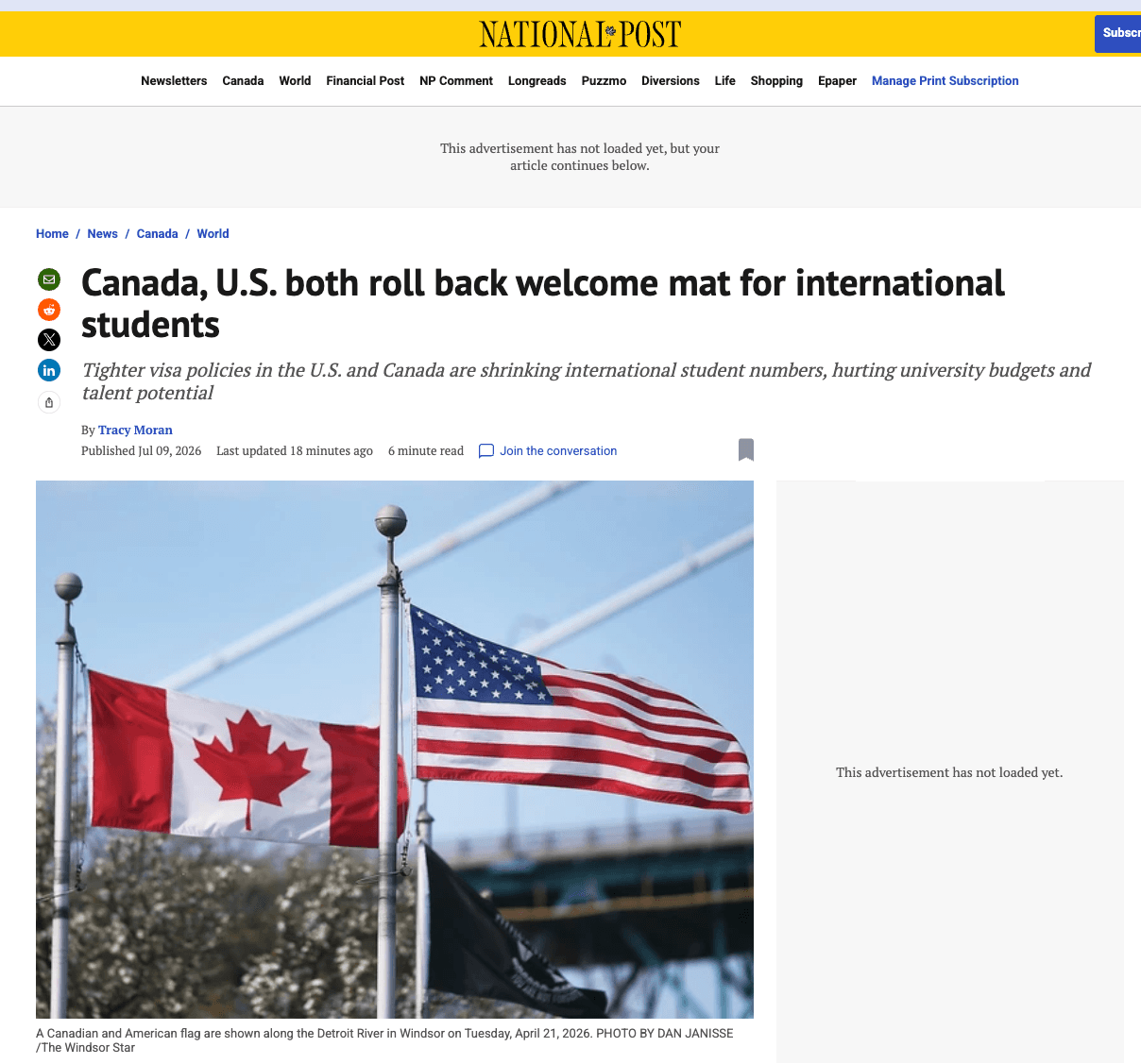
Stricter visa policies are shrinking international student numbers on both sides of the border. Loren Locke, a former U.S. consular officer, tells the National Post that social-media vetting, thinned-out interview appointments, and abrupt visa revocations since 2025 would each “give a prospective student pause.”
From the Article
"Since 2025, the State Department has layered mandatory social-media vetting onto every student visa applicant; paused and then thinned out interview appointments; and abruptly revoked hundreds of current students' visas."
"Each of those alone would give a prospective student pause."
Locke Immigration Law's Take
The National Post frames this as an enrollment story — a 17 per cent drop in new U.S. international students, a 36 per cent decline in student visas issued in 2025, applications falling at 59 per cent of institutions. But Loren's list of what changed is really a description of friction compounding at every stage of a single journey: social-media vetting on every applicant, interview appointments paused and then thinned, hundreds of visas revoked mid-course. Her point that "each of those alone would give a prospective student pause" is the operative one. No single measure closes the door; together they reset a prospective student's expectation of whether the door will still be open by the time they arrive — and expectations, not statutes, are what move enrollment numbers a year or two out.
The consequence the enrollment figures understate is downstream, and it lands on employers. The international student is the front end of the skilled-immigration pipeline this firm works at the back end of: F-1 study, then Optional Practical Training, then — for STEM graduates — a three-year runway with three shots at the H-1B cap lottery, and eventually an employment-based green card. A supply shock at the student stage propagates through that pipeline on a two-to-three-year lag, which is exactly why the article's separate threats to OPT and to Duration of Status matter more than they look. Companies that have quietly built workforce plans around hiring U.S.-trained international graduates are looking at a thinner candidate pool in 2027 and 2028 for decisions being made — or unmade — at the consulate today.
For the strongest individuals, the durable answer is the one that reduces how often a career depends on a consular officer at all. A student who will qualify for a self-petition category — EB-1A extraordinary ability or the EB-2 National Interest Waiver — or who has a clear H-1B-to-green-card path, is far less exposed to the year-to-year turbulence Loren describes than one relying on repeat visa stamping. None of that is a quick fix, and none of it changes this fall's appointment math. The near-term advice mirrors hers: book interviews as far ahead as possible and treat any travel that forces a new visa application as a decision to plan around, not a formality. The longer-term advice is to start the conversation about permanent, self-directed status earlier than feels necessary — before the next policy shift makes the timing someone else's to decide.
Key Takeaways
- New U.S. international-student enrollment fell 17 per cent last year (steepest at the graduate level), and the State Department issued 36 per cent fewer student visas in 2025; the IIE's Spring 2026 Snapshot found applications down at 59 per cent of U.S. institutions.
- Loren traces the chill to measures layered on since 2025 — mandatory social-media vetting for every student visa applicant, paused-then-thinned interview appointments, and hundreds of mid-course visa revocations — any one of which alone would deter applicants.
- Canada tightened in parallel: study-permit issuances fell 24 per cent in 2024 (to 516,765), the 2025 target was cut to 437,000 and the 2026 ceiling to 408,000, alongside a new Provincial Attestation Letter requirement and a higher cost-of-living proof of $22,895.
- The stakes run past enrollment into the talent pipeline: threats to OPT and to Duration of Status hit the F-1 → OPT → H-1B pathway, and international-student spending added roughly $43 billion to the U.S. economy in 2024-25.