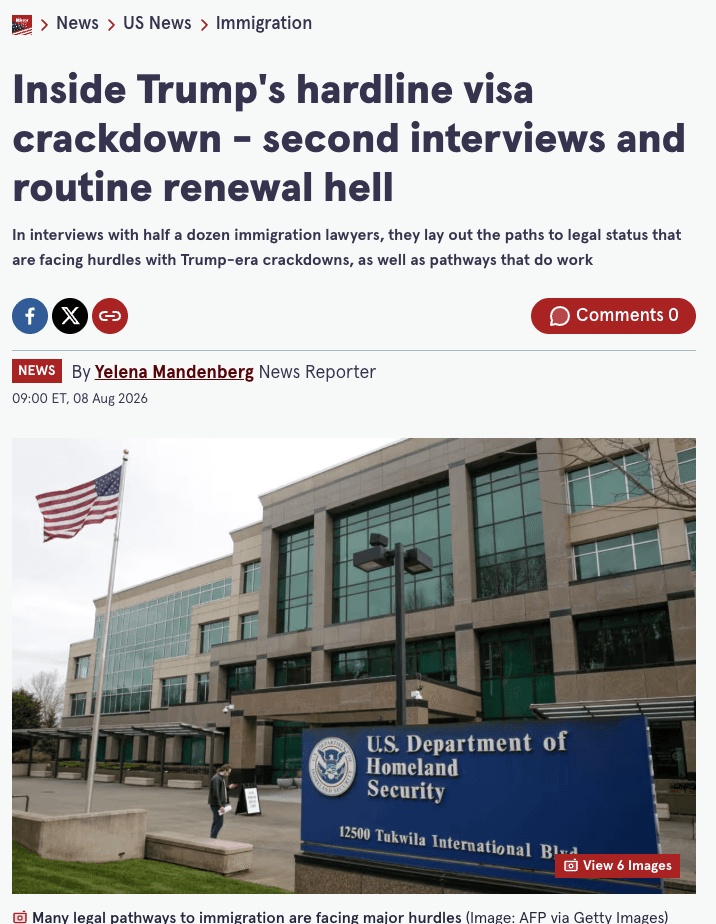
The Mirror US interviews half a dozen immigration lawyers on which legal pathways are jammed and which still work. Loren Locke describes enforcement priorities that have "done a complete 180" and routine renewals stretching to 9-12 months.
From the Article
"The legal grounds for deportation haven't fundamentally changed, but the enforcement priorities have done a complete 180."
"Now we're seeing sweeping raids targeting farmworkers, restaurant staff, and construction workers who have been contributing to their communities and paying taxes for decades. These aren't dangerous criminals—they're the backbone of industries that cannot function without immigrant labor."
"Routine visa renewals that should take weeks are taking 9-12 months. This isn't just bureaucratic inconvenience—it means people's work authorization lapses, businesses lose critical employees through no fault of anyone except the broken system, and legitimate business operations are disrupted."
"USCIS processing delays have created a compliance nightmare for businesses trying to do everything legally."
"It's just not a good time for international students. Teenagers planning their futures … aren't going to be appreciated here."
Locke Immigration Law's Take
The organizing insight of the piece — and the reason Loren's first quote leads it — is that almost nothing in the statute has changed. Overstays, unlawful entries, and certain convictions have always been removal grounds. What changed is how the government applies the tools it already had: who gets targeted, how fast cases move, and how little slack the system leaves for people who are following the rules. That distinction matters for planning, because it means the risk profile of any given case is being set by enforcement posture, not by law — and posture can shift faster than clients or employers can react.
For the firm's business clients, the renewal numbers are the operative part. DHS ended the extended automatic grace period for pending work-permit renewals in 2025, renewals are running nine to twelve months regardless of premium processing, and USCIS will not accept a filing more than six months out — so an employee can do everything right and still lose authorization mid-case, and the employer loses a trained worker with no one to blame but the queue. Loren's "compliance nightmare" framing is the right one: companies are now getting notifications about employees' immigration status and watching authorizations terminated early, which puts I-9 compliance, workforce planning, and the renewal calendar in the same conversation. The mitigation is unglamorous but real — calendar every expiration, file on the first eligible day, and identify which critical employees should be moved toward statuses that don't require annual renewal at all.
The student quote is the forward-looking one. A hard four-year F-1 limit from September 15, 2026, thinner grace periods, and expanded social media screening land on exactly the population that feeds the F-1-to-OPT-to-H-1B pipeline U.S. employers quietly depend on. A graduate who must secure sponsorship — and a government answer — inside a compressed window is a graduate many employers will lose to the queue. The candidates with options will increasingly be the ones who start early on a status with permanence built in: an employer-backed green card, or for the strongest, a self-petitioned EB-1A or National Interest Waiver that doesn't hinge on anyone's sponsorship timeline.
Key Takeaways
- Half a dozen immigration lawyers agree the law hasn't fundamentally changed — enforcement has. Loren: the priorities have "done a complete 180," with raids now sweeping up long-settled taxpaying workers.
- Work-permit renewals that should take weeks are running 9-12 months with no extended grace period, and USCIS won't accept filings more than six months before expiry — authorization lapses and staffing losses are now built in.
- Marriage-based cases face second interviews with questioning that reaches back to filings from years ago; new guidance may push some applicants, including spouses of U.S. citizens, into consular processing abroad.
- Some routes still function: E-2 and O-1 cases are moving, religious-worker approvals are quick, and employment-based and family petitions remain open — with longer timelines and a higher premium on preparation.