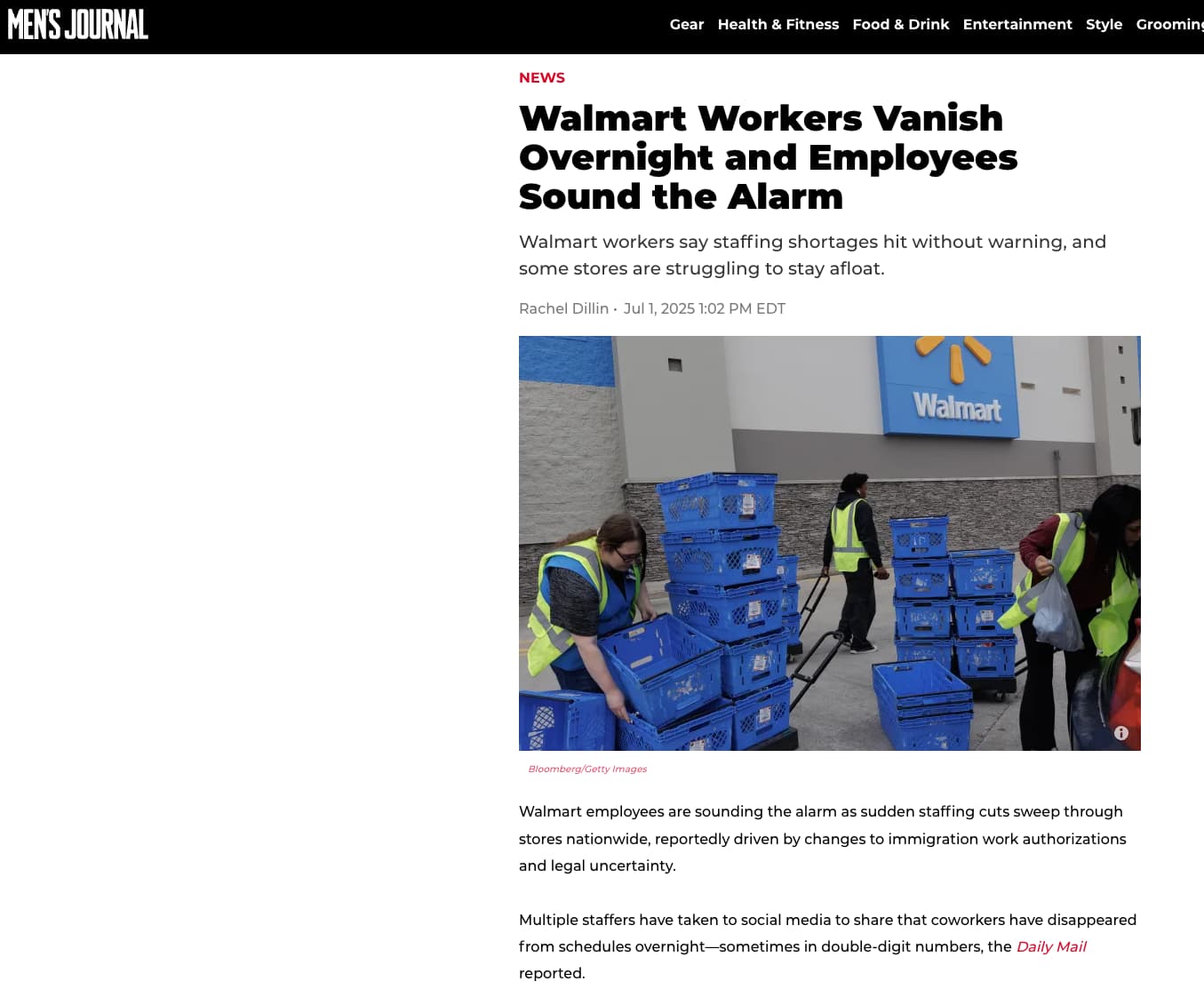
Men's Journal quotes Loren Locke on the impact of immigration policy on Walmart's workforce.
From the Article
"Employers like Walmart have no choice but to stop employing workers who lack US work authorization. But it is tricky to comply when they have a large number of current employees whose work permits are getting cancelled prematurely."
Locke Immigration Law's Take
The Men's Journal coverage of "Walmart workers vanishing overnight" tells the story from the side that gets the least airtime in policy debates: the workers themselves. As Loren noted in the article, "employers like Walmart have no choice but to stop employing workers who lack US work authorization" — but for the affected employees, that's not an enforcement mechanism; it's a paycheck disappearing without warning. A worker whose CHNV parole is revoked or whose TPS designation expires loses authorization on a calendar date, often without individualized notice. The next shift becomes the last shift.
The compounding effect is that affected workers usually don't have a soft landing. The same status reclassification that ends current employment also closes most alternative employment paths — a worker without authorization can't switch to a different employer for the same role. Family members on derivative status face the same disruption simultaneously. Children in school, mortgages on homes, vehicle financing, all anchor to a household income that's now zero.
For workers whose status is at risk and who haven't yet lost authorization, the planning window is now and it's narrower than most realize. We work with employees in this situation regularly to identify alternative pathways: family-based sponsorship if a US-citizen or permanent-resident family member is available; employer-sponsored green cards (PERM-based EB-3 for unskilled, EB-2 for higher-skilled roles) if the current employer can be persuaded to file; self-petitions like EB-1A or NIW for workers whose profiles support extraordinary-ability or national-interest claims. None of these are quick. But they all start with a current authorization status — the moment the status lapses, the option set narrows further.
Key Takeaways
- For affected workers, "Walmart vanishings" aren't enforcement events — they're sudden paycheck losses without individualized notice.
- The compounding effect: status reclassification that ends current employment also closes most alternative employment paths simultaneously.
- The household impact is total: derivative-status family members lose authorization at the same time; mortgages, vehicle financing, schooling all anchor to income that's now zero.
- Planning before status lapses preserves options: family-based sponsorship, employer-sponsored green cards (PERM-based), self-petitions (EB-1A, NIW). The option set narrows once authorization expires.