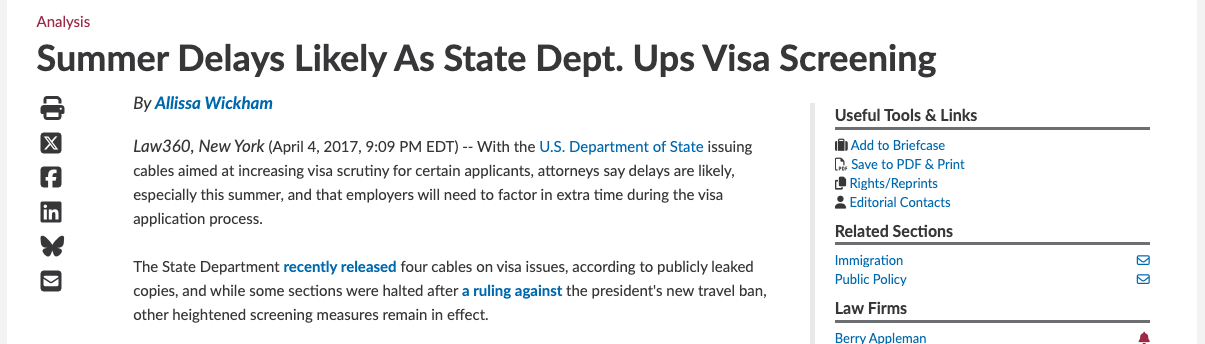
Law360 features Loren Locke discussing anticipated summer delays as the State Department increases visa screening.
From the Article
"I expect that the U.S. consulates in India are going to be particularly affected because they will [potentially] have a lot of people that fall into this extra screen, and they have a lot of people that want to come here."
Locke Immigration Law's Take
The April 2017 Law360 piece captured the early signal of the visa-screening expansion that's now structural. Loren's prediction at the time — that "U.S. consulates in India are going to be particularly affected because they will potentially have a lot of people that fall into this extra screen, and they have a lot of people that want to come here" — was right on both counts. India-post wait times have climbed steadily across the decade, and the "extra screen" Loren named in 2017 has expanded into the layered vetting regime that's currently producing six-month-plus waits at most India posts and longer at the most-affected.
What 2017 actually demonstrated, in retrospect, is the asymmetry built into consular-network capacity. Volume hits some posts harder than others — India consulates serve massive H-1B and family-immigration populations against fixed officer counts. When a screening enhancement adds time per case, the post's queue extends in proportion to its baseline volume. India posts compound; lower-volume posts absorb the same screening change without comparable backlog growth.
For 2026 employer-clients sponsoring Indian-national workers, the operational planning question is the same one Loren implicitly named in 2017: don't plan around a generic State-Department average. Plan around the specific consular post the worker will use. Mumbai's wait differs from Hyderabad's, which differs from Chennai's, which differs from Delhi's. Some posts have third-country workarounds (workers traveling to lower-volume posts in nearby countries to complete consular processing). Whether that's a sensible move depends on the case profile, the client's risk tolerance, and the relative timing across alternative posts. The 2017 signal hasn't reversed.
Key Takeaways
- The 2017 visa-screening expansion Loren flagged was an early instance of the layered vetting regime now producing structural delays at high-volume consulates.
- Consular-network capacity is asymmetric: when a screening enhancement adds time per case, high-volume posts (India consulates) compound queue growth while lower-volume posts absorb the same change.
- Practical planning for Indian-national workers in 2026: plan around the specific consular post, not a State-Department average. Mumbai/Hyderabad/Chennai/Delhi wait times differ.
- Third-country consular processing is a real workaround at some posts; sensibility depends on case profile, risk tolerance, and relative timing across alternative posts.