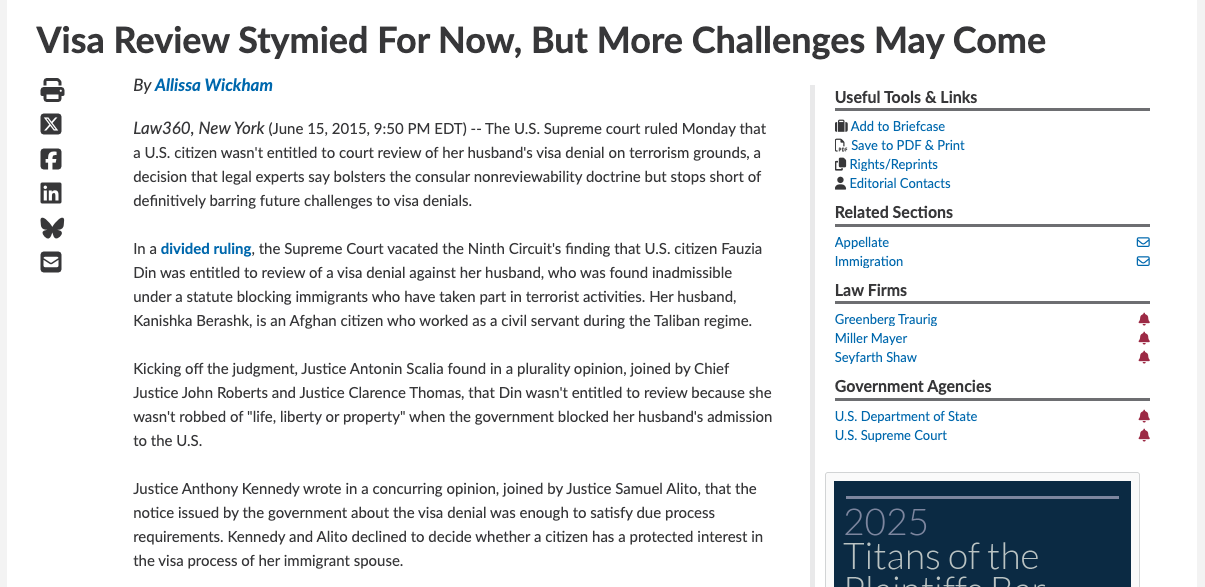
Law360 features Loren Locke discussing the Supreme Court's decision on consular nonreviewability.
From the Article
"I think there's definitely room for there to be another decision in the future on the issue of consular nonreviewability."
"This decision really didn't answer our questions, and it did not close that off for the future."
Locke Immigration Law's Take
The June 2015 SCOTUS decision Loren analyzed in this Law360 piece — Kerry v. Din, addressing whether a US citizen could obtain judicial review of her foreign-national husband's visa denial — left consular nonreviewability mostly intact while declining to fully resolve the underlying constitutional question. As Loren observed at the time: "this decision really didn't answer our questions, and it did not close that off for the future. I think there's definitely room for there to be another decision in the future on the issue of consular nonreviewability."
She was right. The Supreme Court's 2024 decision in Department of State v. Muñoz revisited the exact terrain — whether a US citizen has a constitutionally protected liberty interest in her foreign-national spouse's visa adjudication — and ruled against the citizen plaintiff, more decisively narrowing the door Kerry v. Din had left ajar. Between 2015 and 2024, the consular-nonreviewability doctrine moved from "open question" to "more clearly settled against review" with the practical implication for practitioners that visa denials at consulates have even fewer judicial review pathways than were available a decade ago.
For 2026 clients facing or anticipating a consular denial, the operational implications of the 2015–2024 doctrinal arc matter. The case for over-investing in pre-interview preparation is now stronger because the recourse if things go wrong is genuinely limited. Mandamus actions challenging unreasonable processing delay remain viable in some circuits; Administrative Procedure Act challenges to specific procedural failures are sometimes available; but full-merits review of a consular officer's denial decision is essentially foreclosed for most cases. The firm's preparation discipline reflects this — the goal is to make the denial scenario small enough not to need litigation rather than to plan around litigation pathways that mostly don't exist.
Key Takeaways
- Loren's 2015 prediction — that Kerry v. Din "didn't answer our questions and didn't close that off for the future" — was right. The Supreme Court returned to consular nonreviewability in 2024's Department of State v. Muñoz, ruling more decisively against judicial review.
- The 2015–2024 doctrinal arc moved consular nonreviewability from "open question" to "more clearly settled against review" — visa denials at consulates have fewer judicial review pathways now than a decade ago.
- Limited remaining pathways: mandamus actions for unreasonable processing delay, APA challenges to specific procedural failures. Full-merits review of consular denials is essentially foreclosed for most cases.
- Practical implication: pre-interview preparation discipline matters more than ever because post-denial recourse is genuinely limited. Make the denial scenario small enough not to need litigation.