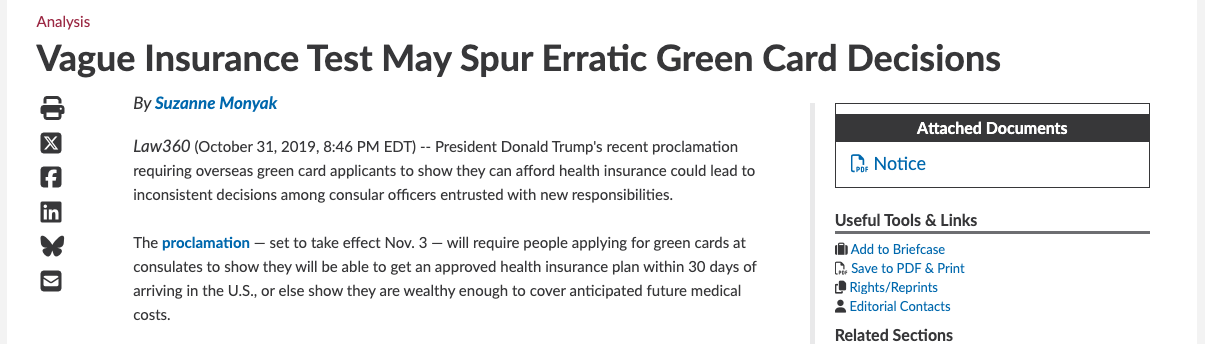
Law360 quotes Loren Locke on the public charge insurance test and its impact on green card applicants.
From the Article
"The form, while informative, is not designed for consular officers to make predictions about future medical conditions."
"Confusion will lead to inconsistent decisions across consulates, and even between officers at the same post."
Locke Immigration Law's Take
The 2019 health-insurance proclamation that Loren analyzed in this Law360 piece — requiring overseas green-card applicants to demonstrate ability to afford health insurance within 30 days of US entry — was eventually enjoined and never took effect at scale. But Loren's two specific objections stand as a useful template for evaluating similar policy proposals when they recur: "the form, while informative, is not designed for consular officers to make predictions about future medical conditions," and "confusion will lead to inconsistent decisions across consulates, and even between officers at the same post."
Both objections generalize. Whenever a policy asks consular officers to make predictive judgments based on data the standard intake form wasn't designed to surface, the consular network produces inconsistent decisions across posts. The 2019 insurance test was an early example. The 2020 public-charge rule (a related but distinct mechanism) showed the same pattern. The 2025 social-media-vetting protocols — where officers evaluate digital-footprint patterns against vague "national-security" criteria — exhibit the same structural problem. Predictive judgments require consistent training data and clear evaluation criteria. The consular network has neither when policies move faster than its officer-training cycle.
For applicants and sponsors evaluating any new policy that introduces consular-officer discretion in 2026, the 2019 framework Loren named applies: identify what the standard form actually asks; identify what the policy now asks officers to evaluate; identify the gap between the two. That gap is where inconsistent decisions concentrate. The defensive move, where the firm is involved, is to over-document the specific factual record relevant to the new criteria — not to rely on the standard intake form's framing — and to be prepared to engage with post-specific patterns when the same case profile gets different outcomes across consulates.
Key Takeaways
- The 2019 health-insurance proclamation was enjoined and never took full effect, but Loren's two objections (form not designed for predictive judgments; inconsistent decisions across posts) became a template for similar policy proposals.
- The pattern recurs: 2020 public-charge rule, 2025 social-media-vetting protocols all exhibit the same structural problem — predictive consular discretion outpaces officer training and consistent evaluation criteria.
- Inconsistent decisions concentrate in the gap between what the standard form asks and what the policy now asks officers to evaluate.
- Defensive move: over-document the specific factual record relevant to the new criteria; engage with post-specific patterns when the same profile gets different outcomes across consulates.