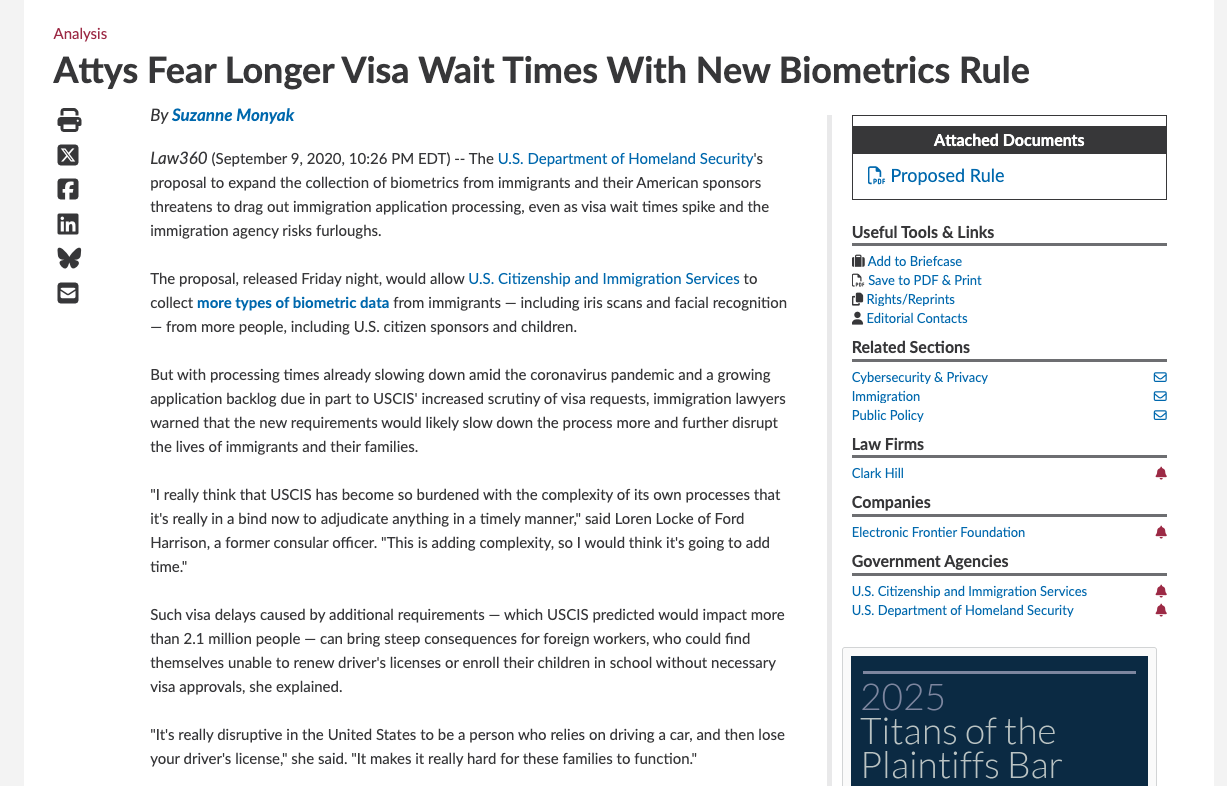
Law360 quotes Loren Locke on the Department of Homeland Security's new biometrics collection rule.
From the Article
"USCIS has become so burdened with complexity of its own processes that it's in a bind to adjudicate matters timely."
"I find it incredibly invasive...I do not understand why existing methods are insufficient."
Locke Immigration Law's Take
The 2020 DHS biometrics rulemaking — eventually withdrawn in 2021 but re-proposed in updated forms since — generated Loren's two-pronged objection in this Law360 piece. The first is operational: "USCIS has become so burdened with complexity of its own processes that it's in a bind to adjudicate matters timely." The second is privacy-driven: "I find it incredibly invasive... I do not understand why existing methods are insufficient." Both objections continue to apply to the agency's current direction.
The bandwidth concern in particular is the through-line. USCIS in 2020 was already saturated by procedural complexity; USCIS in 2026 has added the EB-1A vetting center, expanded H-1B documentation requirements, the resumption of in-person interviews for most categories, and the archiving of USCIS's guidance on options for terminated nonimmigrant workers and sharply tightened scrutiny of post-termination change-of-status filings (the 60-day grace period under 8 CFR 214.1(l)(2) remains on the books, but the B-2 "bridge" strategy now draws RFEs, NOIDs, and denials, and NTAs have reportedly been issued to some workers even within the grace period). Each addition is defensible in isolation. Stacked, they push adjudication timelines longer, with the result Loren predicted in 2020 — slower processing across the board — now playing out at scale.
For applicants and employers planning around current adjudication timelines, the practical observation is that the bandwidth problem isn't going to resolve through agency-level fixes. The mechanisms that produce timeline pressure (added documentation, vetting layers, in-person interviews, hostile treatment of post-termination options) operate in the same direction. Planning has to assume long timelines, build in slack, and use whichever filing pathways carry the smallest documentation burden for the case at hand. For most employer-sponsored cases, that's still PERM-based green-card sponsorship; for individual self-petitions, EB-1A and NIW remain shorter-document-trail than alternatives.
Key Takeaways
- Loren's 2020 two-pronged objection to the DHS biometrics rule (USCIS already burdened by self-imposed complexity; existing methods sufficient) still applies to the agency's current direction.
- The 2020 bandwidth concern has compounded: EB-1A vetting center, expanded H-1B documentation, resumed in-person interviews, tightened post-termination enforcement (archived guidance, B-2 bridge scrutiny) each add adjudication-time pressure.
- The bandwidth problem isn't resolving through agency-level fixes — the mechanisms producing timeline pressure all operate in the same direction.
- Planning implication: assume long timelines, build slack, prefer pathways with smaller documentation burdens (PERM for employer-sponsored, EB-1A/NIW for self-petition).