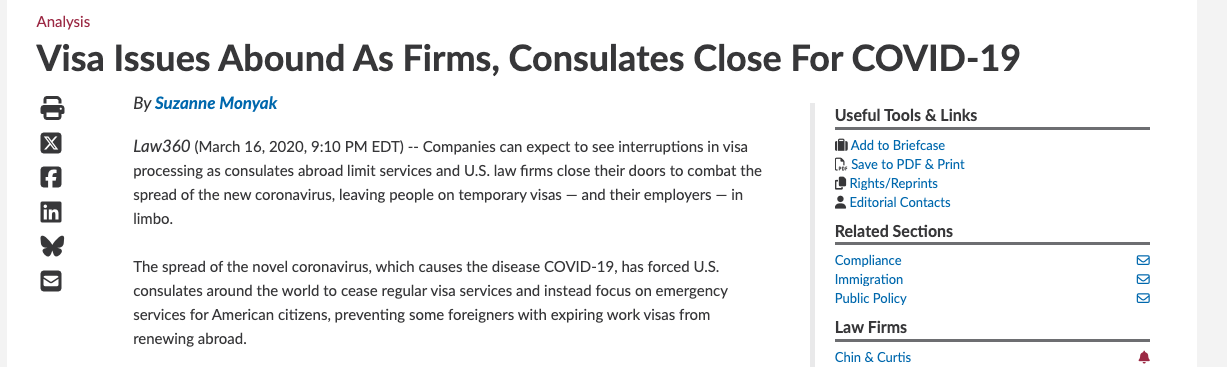
Law360 features Loren Locke discussing how COVID-19 is disrupting visa processing worldwide.
From the Article
"There are just so many things in immigration law that are so strict and unforgiving about paperwork."
"We're particularly poorly situated for a knee-jerk transition to digital."
Locke Immigration Law's Take
Two days after the WHO declared COVID-19 a pandemic, Law360 captured Loren's framing of the immigration system's specific vulnerability to the moment: "There are just so many things in immigration law that are so strict and unforgiving about paperwork. We're particularly poorly situated for a knee-jerk transition to digital." Most of the system was paper-first, signature-required, and predicated on in-person consular interviews. The pandemic forced rapid adaptation across all three constraints, with mixed results that have shaped the system since.
What 2020 actually demonstrated, in retrospect, is what the immigration system can and can't adapt. Document-handling went mostly digital and mostly stayed there — USCIS now accepts scanned copies of wet-signed paper forms (true e-signatures remain valid only on its online filings), allows online status checks, and handles a growing set of applications through online portals. In-person interviews mostly came back, with only narrow exceptions for low-risk renewals. The middle category — the documents and procedures that require wet signatures, original certified records, or in-person delivery — remained stubbornly analog because the regulatory framework underneath them assumes paper.
For 2026 clients navigating the current adjudication landscape, the 2020 lesson holds. Where the regulatory framework permits digital handling, the system has converged toward digital. Where it doesn't, no amount of pandemic urgency was enough to change it. Plan filings around the actual current rules, not around what would be operationally convenient. The firm's filing-preparation discipline — including original-document custody, wet-signature timing, and consular interview readiness — is the part that hasn't been disrupted since 2020 because the underlying regulations didn't change.
Key Takeaways
- The 2020 pandemic forced rapid digital adaptation across document handling, signatures, and in-person interviews — with mixed results that have shaped the system since.
- Document handling went mostly digital and stayed there; in-person interviews mostly came back; the middle category (wet signatures, original certified records, in-person delivery) remained analog because the regulatory framework assumes paper.
- The 2020 lesson holds in 2026: where regulations permit digital handling, the system has converged digital; where they don't, urgency wasn't enough to change them.
- Filing-preparation discipline (original-document custody, wet-signature timing, interview readiness) is the part that hasn't been disrupted because the underlying regulations didn't change.