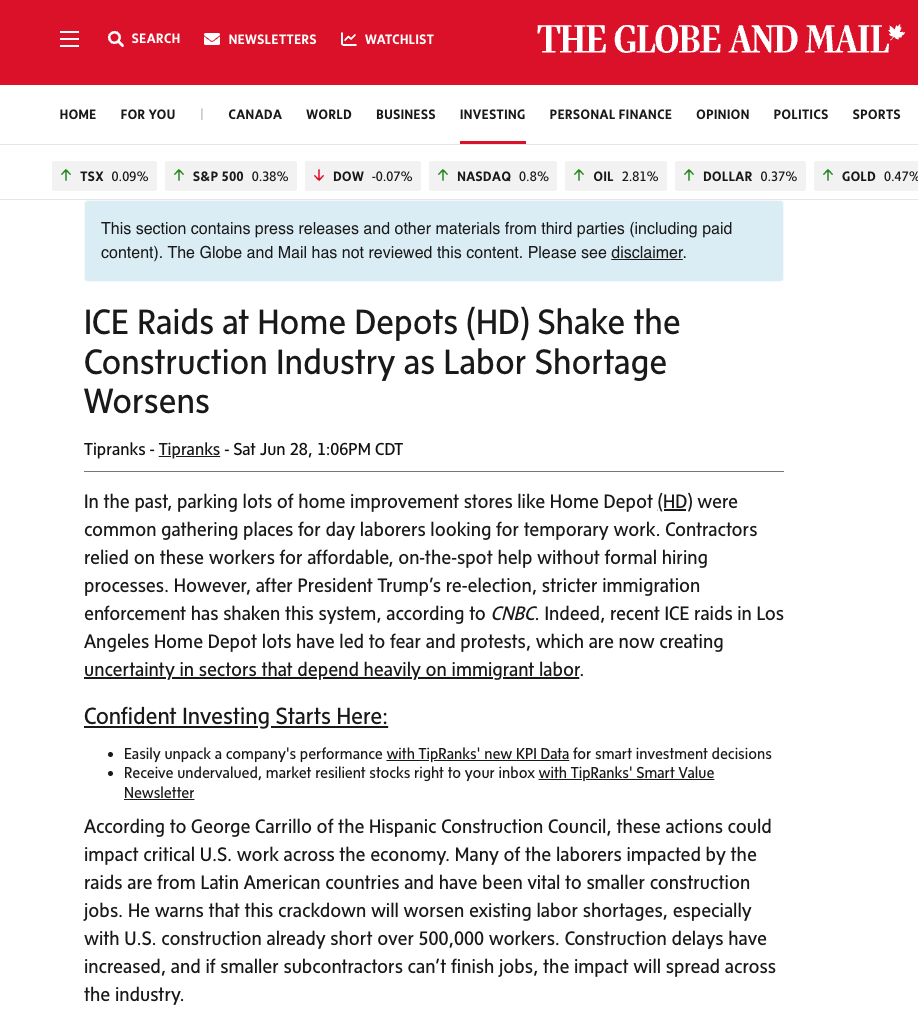
The Globe and Mail features Loren Locke discussing ICE enforcement operations at Home Depot locations.
From the Article
"Immigration attorney Loren Locke criticized the raids as targeting easy, non-threatening individuals rather than solving deeper problems."
Locke Immigration Law's Take
The Globe and Mail piece sits at the intersection of two trends our employer-clients track separately: the construction industry's structural labor shortage (over 500,000 workers short, per the article's reported figures), and the disruption to the informal day-labor system the construction industry has historically used to flex against demand. ICE raids at Home Depot parking lots in Los Angeles disrupt the latter directly, and the cascade through general contractors → subcontractors → project timelines is exactly what the article documents.
What's less obvious from the headline framing: Home Depot itself isn't responsible for the day-labor activity in its parking lots. The store's own no-solicitation policy disclaims involvement, and the workers gathering there are independent. The raids work because the location concentrates the available population, not because the location implicates the corporation. For other industries that depend on similar concentrate-and-hire patterns — agriculture day haul, construction site staging, hospitality on-call — the operational lesson is the same: the location pattern is the vulnerability, not the worker's individual status.
For construction-industry clients specifically, the planning conversation we're having now centers on three options: formal sponsorship pipelines for the workers the firm wants to retain long-term (PERM-based green cards for skilled trades, EB-3 unskilled where applicable), structured staffing-agency arrangements that put the I-9 compliance burden on the staffing partner rather than the project, and project-bid pricing that reflects the workforce-friction premium. As Loren put it in the article, the raids target "easy, non-threatening individuals" rather than addressing the deeper structural mismatch — but for construction firms managing actual projects, the fix is operational, not rhetorical.
Key Takeaways
- US construction faces a 500,000+ worker shortage; ICE raids at Home Depot parking lots disrupt the informal day-labor system the industry has used to flex against demand.
- Home Depot itself isn't implicated — its no-solicitation policy disclaims involvement; the raids exploit location concentration, not corporate liability.
- The location-concentration pattern is the structural vulnerability for industries beyond construction (agriculture day haul, hospitality on-call, site staging).
- Construction-industry adaptation: formal sponsorship pipelines (PERM, EB-3) for retention-priority workers, structured staffing-agency arrangements that shift I-9 burden, bid pricing that reflects workforce friction.