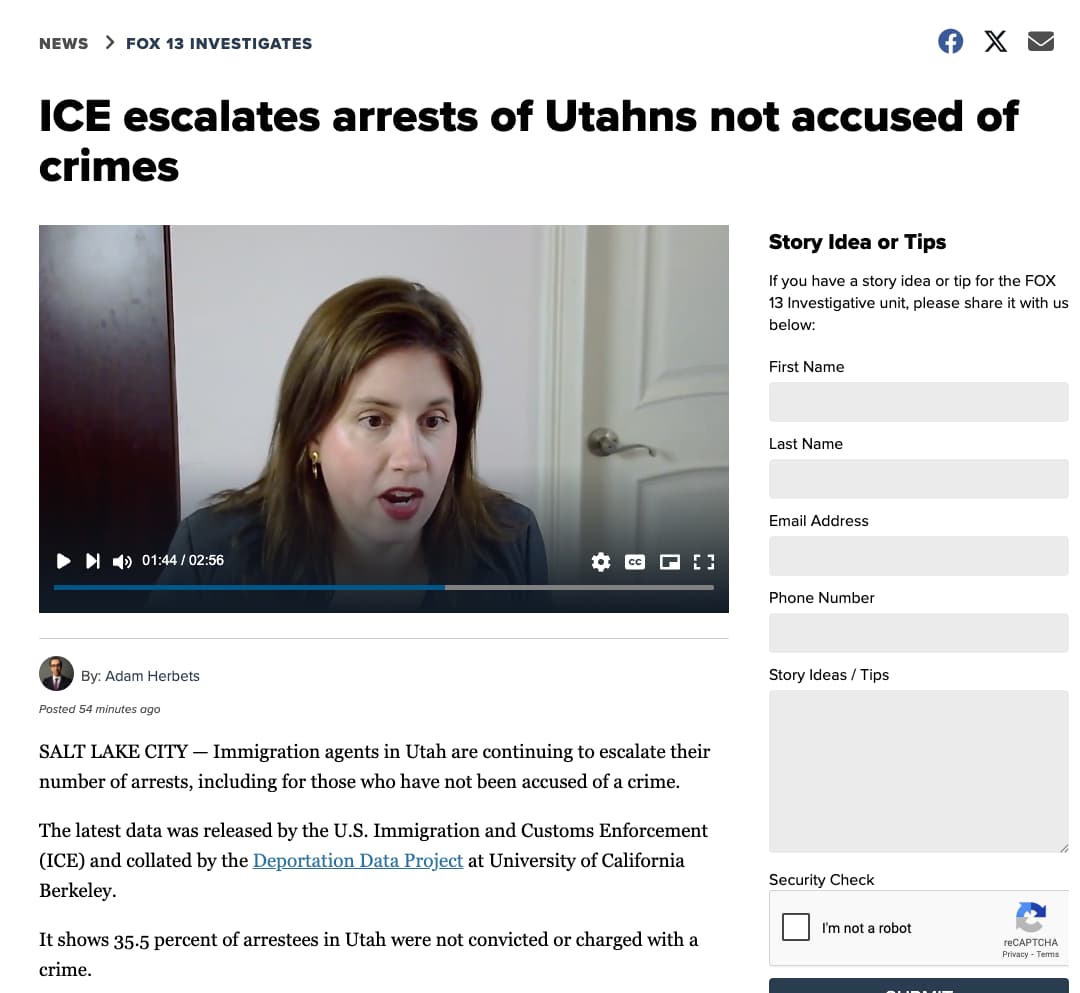
Fox 13 Salt Lake City interviews Loren Locke about ICE operations resulting in the arrest of Utah residents.
From the Article
"The quota was set ambitiously high, and, if you pair that with a decrease in border crossings, you don't have this pool of people that have only been here for a couple of days or a couple of weeks. You're trying to hit these big numbers, but if we're only focusing on violent criminals? Well, violent criminals are serving out their sentence."
Locke Immigration Law's Take
The Fox 13 reporting puts numbers on what's been mostly anecdotal: in Utah, 35.5% of ICE arrestees in the January–June 2025 window had no convictions or charges; arrests jumped from 630 in the same period in 2024 to 1,400 in 2025; nationwide, the share of ICE arrestees with prior convictions fell from 52% in 2024 to 41% in 2025 (Washington Post data the article cites). The mechanical driver Loren named in the article is straightforward: a 3,000-arrest-per-day quota set by the White House in May, paired with a documented decrease in border crossings, mathematically forces enforcement away from violent-criminal targets and toward whatever pool of removable individuals is reachable. "Violent criminals are serving out their sentence," as Loren put it. Quotas applied to the available population produce the data the article reports.
For our employer-clients with foreign-national workforces, the Utah numbers signal a broader risk: the population at risk of detention now includes long-tenured employees with no criminal history, including workers in lawful status whose status has been administratively reclassified. The "violent criminals" target population isn't where the marginal arrest is happening. The marginal arrest is happening at workplaces, traffic stops, and family encounters where the encountered person is reachable and removable, regardless of the threat level the original policy framing implied.
The practical guidance we're giving employer-clients in mid-2026 has hardened from where it was a year ago: maintain current I-9 documentation, know which employees are status-conditional and what their renewal dates are, brief managers on what to do (and not do) during workplace ICE encounters, and ensure HR has reachable immigration counsel during business hours. The Utah data suggests the encounters won't necessarily be at the workplace, but the documentation hygiene that protects the employer is the same regardless of where the encounter happens.
Key Takeaways
- 35.5% of Utah ICE arrestees in January–June 2025 had no convictions or charges; arrests roughly doubled year-over-year (1,400 vs. 630 in 2024).
- Nationally, the share of ICE arrestees with prior convictions fell from 52% (2024) to 41% (2025) per Washington Post data.
- The mechanical driver: a 3,000-arrests-per-day quota mandated by the White House in May 2025, applied against a documented decrease in border crossings, forces enforcement toward whatever removable population is reachable.
- The marginal arrest is happening at workplaces, traffic stops, and family encounters — not at violent-criminal targets.
- Practical employer guidance: tight I-9 documentation, status-conditional-employee tracking, manager briefings on workplace encounters, immigration counsel reachable during business hours.