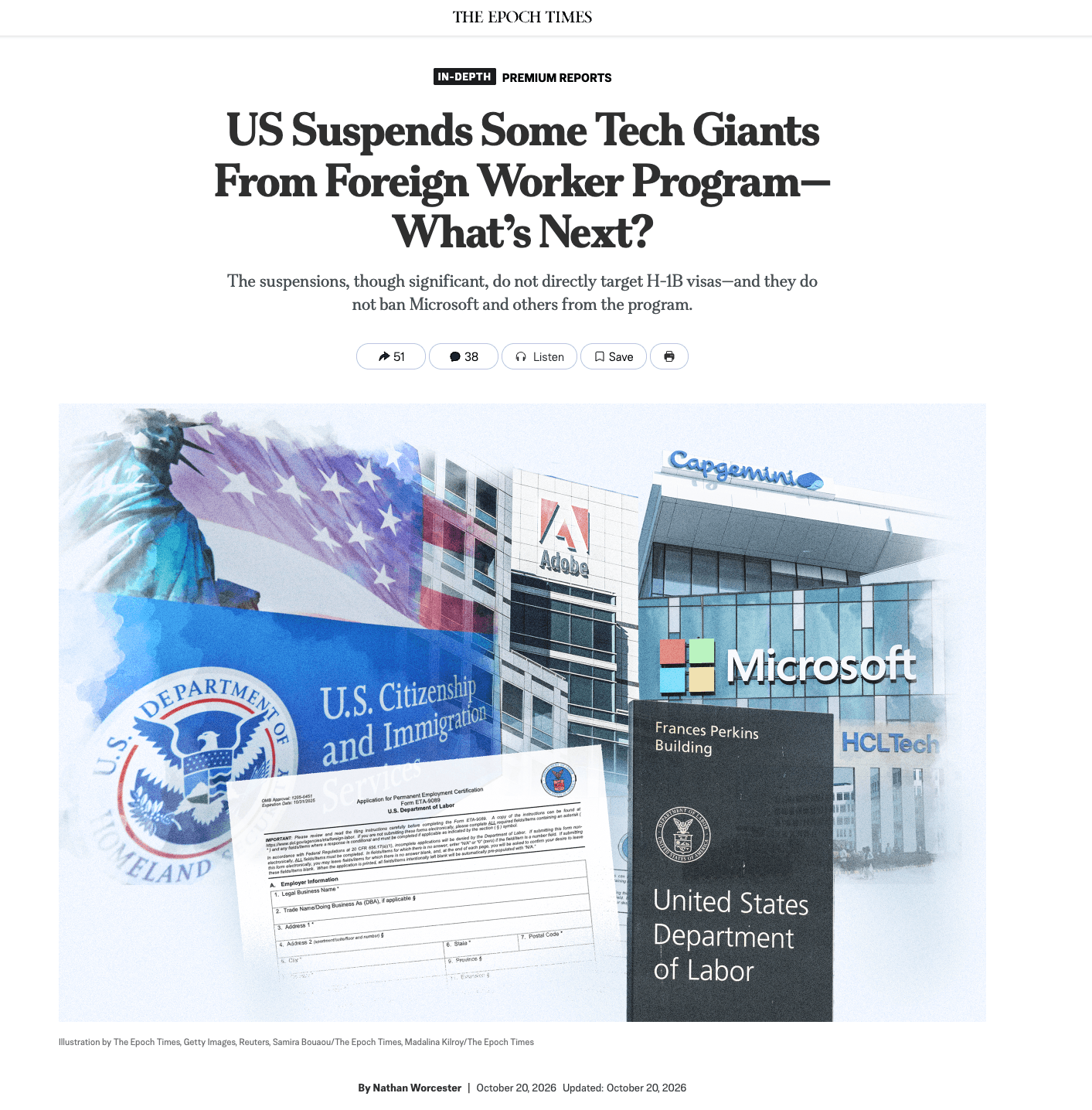
The Epoch Times asks what the Labor Department's PERM suspension of Microsoft, Adobe, Infosys and five other employers means next. Loren Locke says the suspension does not directly touch the H-1B, and that employers are being blamed for recruitment steps the law requires.
From the Article
"feels like it must have been designed in a back room to not actually hurt Microsoft that much."
"that is totally separate from getting green cards for their H-1B workers."
"If they don't like it, why are they blaming the employers for doing it when the employers are following the legal requirement and don't have a way out of it?"
"have to drill down into what they really need in their offered role."
Locke Immigration Law's Take
Loren's first point is about who actually feels a PERM suspension. It does not cancel anyone's H-1B, and it does not stop Microsoft from employing the people it already has. What it stops is the first step of the employer-sponsored green card for those employees. For most of them, that is a delay. The people with a real clock are H-1B holders nearing the six-year limit, because staying on H-1B past year six generally depends either on a PERM application or I-140 filed at least a year earlier, or on an approved I-140 for a worker whose green card is held up by the annual per-country or worldwide limits. That is why Loren said that, in that position, she might start looking for another employer. An employee whose I-140 is already approved is in a much stronger position than one with no filing yet.
Her second point is about the recruitment rules. The Labor Department's own regulations require PERM employers to run two print ads, normally in the Sunday edition of a local newspaper, place a job order with the state workforce agency and complete further recruitment steps before they can certify that no qualified U.S. worker applied. Loren agrees the newspaper requirement is outdated. But employers cannot skip it, and the rules also already require the job requirements in those ads to be the employer's actual minimum requirements and, unless justified by business necessity, normal for the occupation. If the administration wants recruitment that reaches more American workers, the fix is to change the regulation, not to fault employers for following it.
For employers, the article's warning about compliance reviews at companies that were not named is the practical takeaway. Now is the time to check that every PERM file's job requirements are documented as real business needs and that the recruitment record is complete. For individual workers at the suspended companies, the step is to map their dates now: H-1B start date and six-year limit, PERM and I-140 status, and priority date. For the strongest candidates, a self-petitioned EB-1A or an EB-2 National Interest Waiver does not need PERM at all, so it does not depend on whether a particular employer is in good standing with the Labor Department.
Key Takeaways
- The Labor Department suspended Microsoft, Adobe, Capgemini, Cognizant, HCL, Infosys, TCS and Wipro from PERM for up to 180 days, with the option to extend; debarment, the actual penalty, would be a separate step.
- Loren Locke: the suspension does not directly affect the H-1B, and the administration's H-1B actions are "totally separate from getting green cards for their H-1B workers."
- Workers nearing the H-1B six-year limit who do not yet qualify to extend past year six are most exposed and may need to consider a move to an unaffected employer.
- The newspaper ads the Vice President criticized are required by Labor Department regulations; employers "don't have a way out of it" until the rule changes.