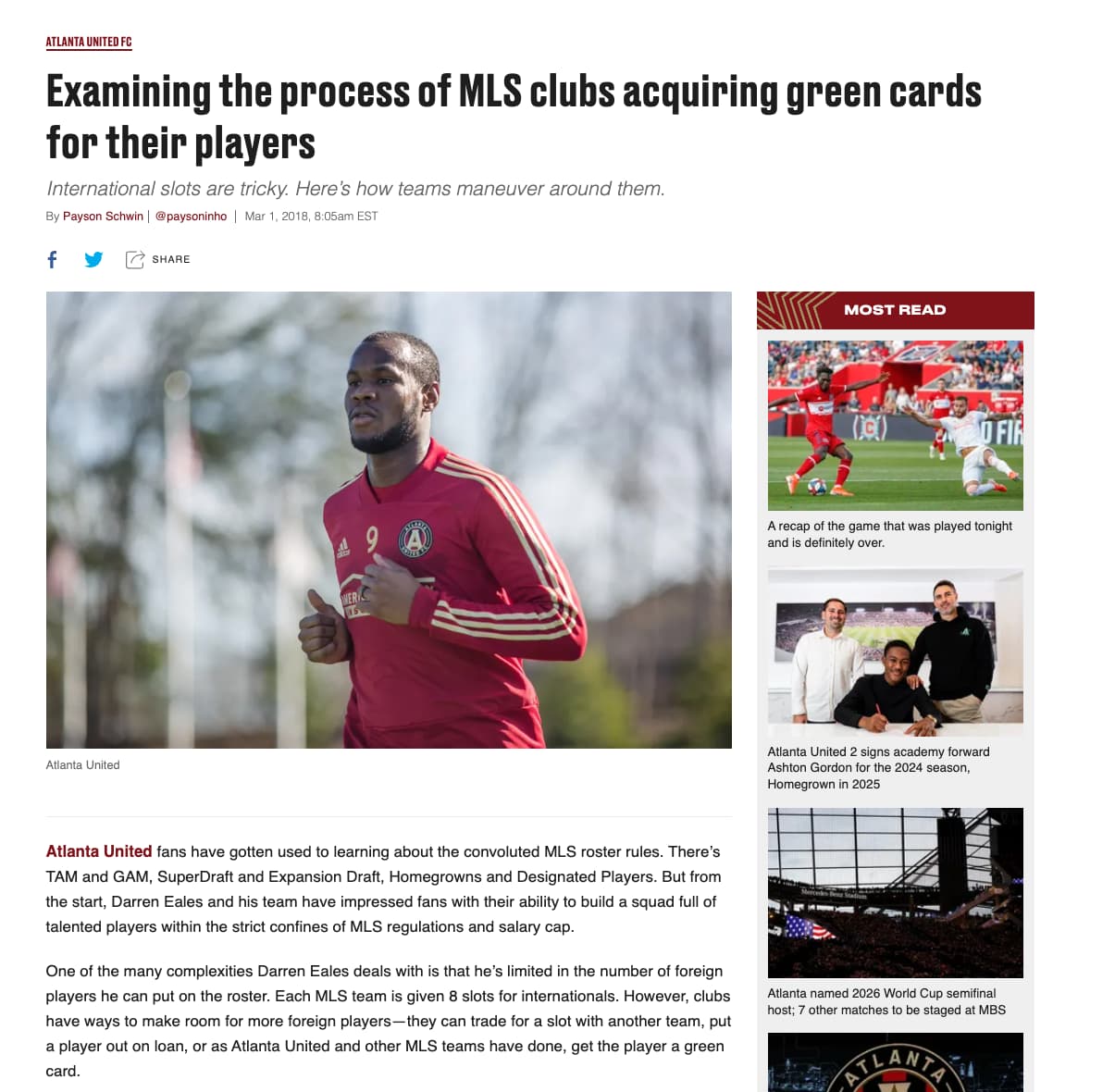
Dirty South Soccer features Loren Locke explaining the immigration process for Atlanta United's international soccer players.
From the Article
"It's really all very convoluted."
Locke Immigration Law's Take
The Dirty South Soccer piece captured the most useful single line about US sports immigration we've seen in print: Loren's "it's really all very convoluted." Major League Soccer's immigration footprint sits at the intersection of three visa categories that don't always map cleanly onto pro-soccer roster mechanics: the P-1A athlete visa for "internationally recognized" athletes, the O-1A visa for athletes with "extraordinary ability," and the longer-term path through EB-1A green cards for the small subset of players whose accomplishments support an extraordinary-ability self-petition.
P-1A is the workhorse for active international players: it's tied to the team, has clear documentation requirements (international recognition, comparable team standing), and can be renewed across contract cycles. Where it gets complicated is the transition points — a player whose career arc justifies an EB-1A self-petition needs to build the petition's record well before the active P-1A period ends, because EB-1A's evidentiary requirements (sustained acclaim, criteria-by-criteria documentation) take 12–24 months to assemble cleanly. Atlanta United's roster, like any MLS roster, includes players in different stages of this transition simultaneously. The "convoluted" framing applies because each player's path depends on their specific career stage, country of origin (visa-bulletin backlogs vary), and intended length of stay.
For sports clients more broadly — soccer, basketball, esports, performing arts — the immigration playbook follows the same shape. P-visas for active competition periods, O-1 where the profile clears the higher extraordinary-ability bar with shorter timeline pressure, EB-1A self-petition for the long-term residency anchor when the player's record supports it. The right pathway depends on roster economics, contract structure, and the player's anticipated career arc. The firm helps athletes, agents, and team front offices map those pathways case by case.
Key Takeaways
- Pro athletes generally use three immigration pathways: P-1A (athlete visa, team-tied), O-1A (extraordinary ability, more flexible), and EB-1A (self-petition green card for sustained-acclaim profiles).
- P-1A is the workhorse for active international players; the transition to longer-term residency requires building EB-1A evidence 12–24 months before the active P-1A period ends.
- The "convoluted" framing applies because each player's path depends on career stage, country of origin (visa-bulletin backlogs), and intended length of stay.
- The firm helps athletes, agents, and team front offices map pathways across roster economics and career arcs — same playbook applies to soccer, basketball, esports, and performing arts.