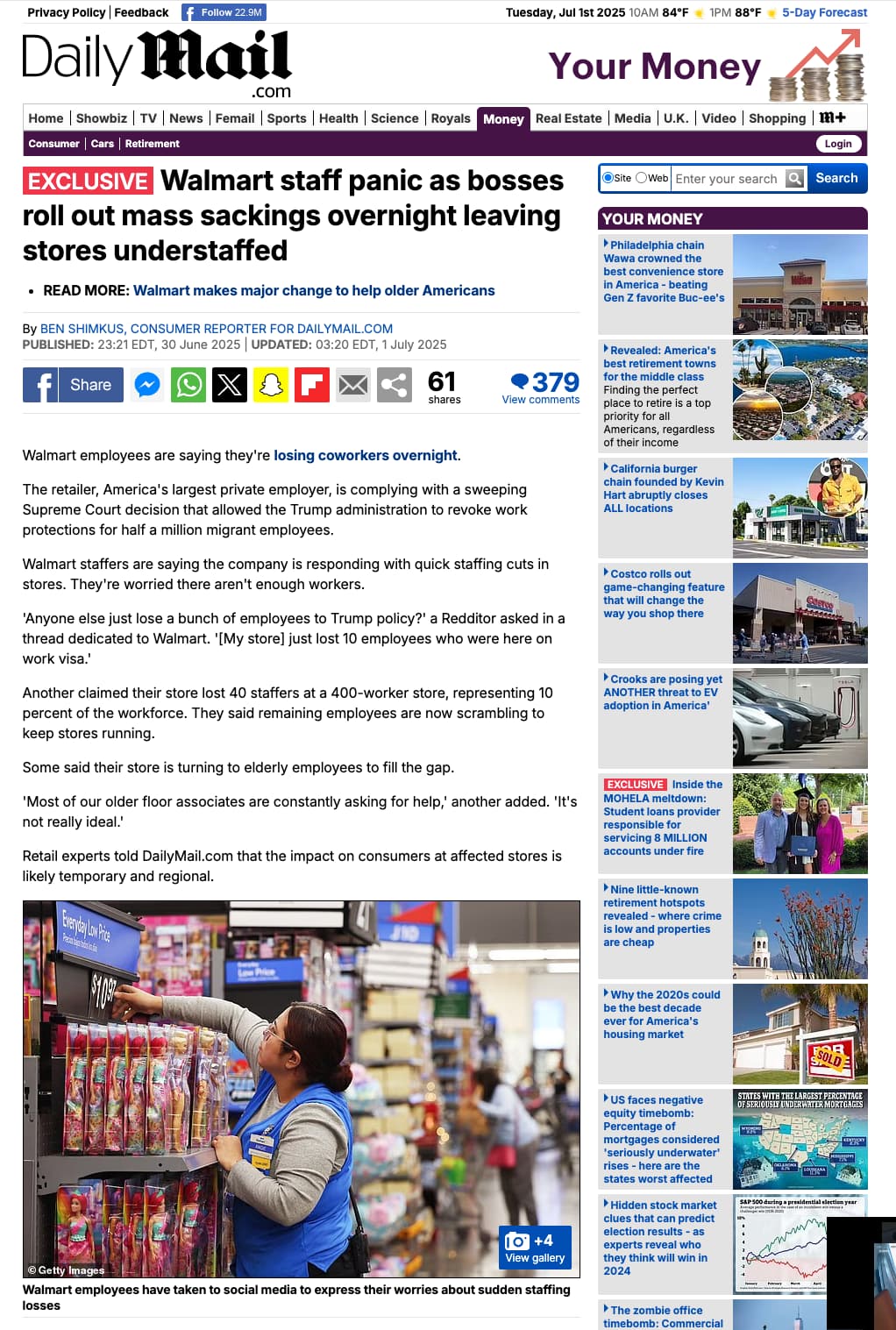
Daily Mail quotes Loren Locke on the business impact of CHNV parole program termination on retailers like Walmart.
From the Article
"Employers like Walmart have no choice but to stop employing workers who lack US work authorization."
"But it is tricky to comply when they have a large number of current employees whose work permits are getting cancelled prematurely."
Locke Immigration Law's Take
The Daily Mail's coverage approaches the Walmart situation through the policy mechanism that's actually driving it: the termination of CHNV parole — the humanitarian parole program for nationals of Cuba, Haiti, Nicaragua, and Venezuela that admitted hundreds of thousands of workers under temporary work authorization. As Loren noted in the article, the legal structure leaves Walmart and other employers "no choice" — when CHNV parole ends, work authorization ends, and continued employment of unauthorized workers exposes the employer to civil and criminal liability. The compliance posture isn't ambiguous; the operational difficulty Loren named is in the speed and scale of the cancellations.
CHNV is one specific case in a broader pattern. Temporary Protected Status designations expire on calendars set by DHS, parole programs (CHNV, U4U for Ukrainians, OAW for Afghans) operate at administrative discretion, and the employer-side workforce impact in each case follows the same shape: a fixed termination date applied to a category, affecting whatever portion of an employer's workforce sits in that category. The Walmart story is a Daily Mail headline this week; agriculture, healthcare, hospitality, and food processing have similar exposures across overlapping populations.
For business clients managing affected workforces, the planning conversation is no longer about whether category-wide terminations will happen — they're happening — but about how to convert as many affected employees as possible to authorization paths that don't depend on the same humanitarian parole framework. PERM-based employer-sponsored green cards are the durable answer for retention-priority workers; H-1B or O-1 if the role qualifies; family-based sponsorship via the employee's own US-citizen or permanent-resident family members where available. None of these are fast, but they survive the next round of category-wide terminations in a way that humanitarian parole no longer does.
Key Takeaways
- CHNV parole termination is one specific case in a broader pattern of category-wide work authorization expirations (TPS by country, U4U for Ukrainians, OAW for Afghans, etc.).
- For employers, the compliance posture is unambiguous (continuing to employ unauthorized workers is illegal); the operational difficulty is the speed and scale of cancellations within affected workforces.
- The pattern affects industries beyond Walmart: agriculture, healthcare, hospitality, and food processing have similar exposures across overlapping populations.
- Durable adaptation: convert retention-priority workers to authorization paths that don't depend on humanitarian parole — PERM-based green cards, H-1B, O-1, family-based sponsorship.