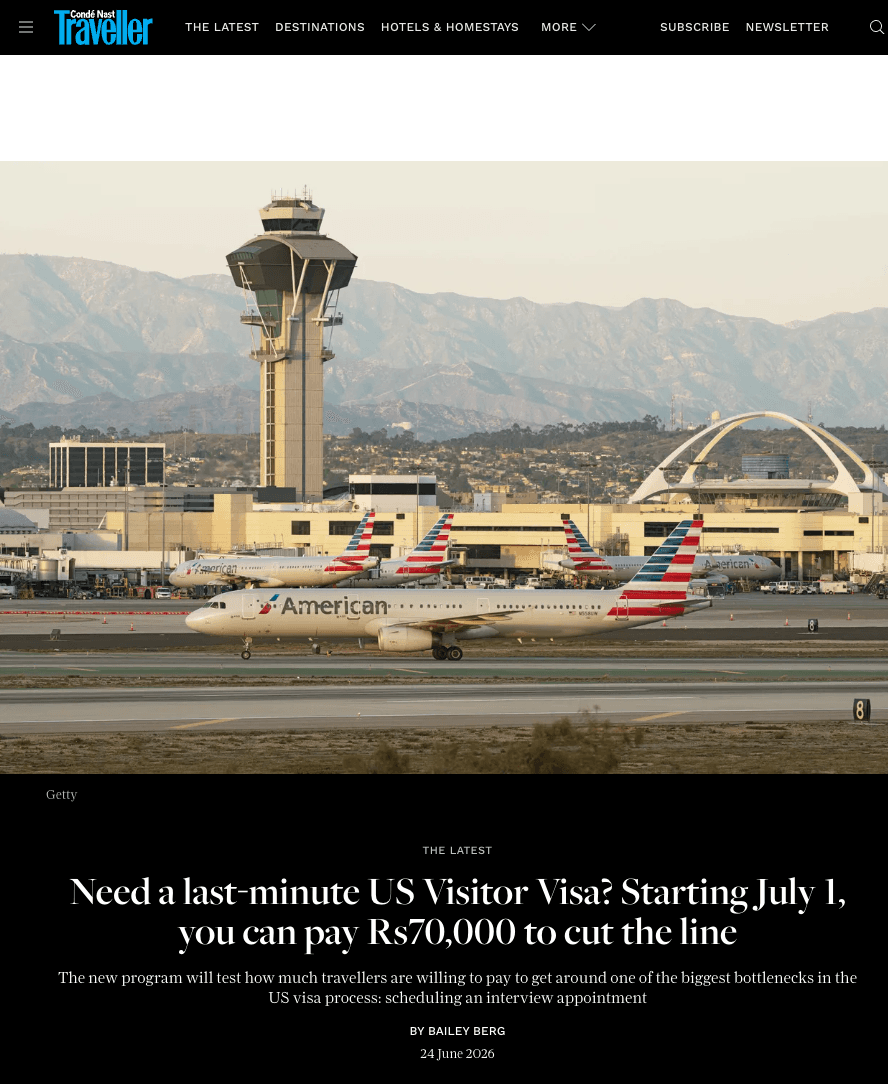
Starting July 1, the US State Department will let visitor-visa applicants pay an extra $750 to secure an interview within 10 business days — Loren Locke, a former consular officer, tells Condé Nast Traveller India the fee buys an earlier date, not a better outcome.
From the Article
"This helps people with money and a deadline: business travellers, urgent medical trips, a wedding or a funeral you can't reschedule."
"For everyone else—the tourist from a country with a year-long wait who's simply trying to plan a vacation—it turns a public service into a tiered one, where the faster lane is the paid lane."
"It's important travellers understand exactly what $750 buys: a faster spot in line, and nothing more."
"It does not make you more likely to get the visa; it doesn't change the eligibility standard; and it doesn't speed up anything that happens after the interview. You're paying for an earlier date on the calendar, not for a better outcome."
Locke Immigration Law's Take
The bottleneck this pilot targets is the interview appointment, not the adjudication — and that distinction is exactly where Loren's consular background is decisive. Having adjudicated roughly 12,000 visa interviews as a State Department officer, she is describing the mechanics precisely: the $750 premium moves an applicant up the scheduling queue, but the standard applied at the window is unchanged. The fee buys a date on the calendar. It does not buy a visa. That is the single most important thing for any traveller to internalize before paying it — a B-1 or B-2 case that would be refused in September will still be refused if it is heard in July.
For the firm's business clients, the practical value is real but narrow. Companies that need to bring an overseas partner, executive, or specialist to the US for a time-sensitive meeting, negotiation, or conference on B-1 business-visitor status have — for the first time — a sanctioned lever for last-minute trips out of high-wait posts. India is the sharp case: US Travel Association data cited in the article showed interview waits exceeding twelve months in that market, and the pilot lets a deadline-driven traveller compress that to ten business days. Loren's framing of who this actually helps — "people with money and a deadline" — is the right lens for deciding whether to spend it. Supply is the catch: slots are capped, not every consulate will participate, the participating-post list is still unpublished, and payment must clear inside a five-to-ten-minute window, so willingness to pay guarantees nothing.
The boundary worth drawing for clients is between speed and substance. A premium appointment is a scheduling tool, not a strategy — it does nothing for the applicant whose underlying eligibility is the real question, and it is emphatically not a workaround for someone who needs to work in the United States. A visitor visa is not a work visa, and the right answer for a foreign hire is almost always the correctly matched work-authorized category, not a faster B-1/B-2 slot. Watch two things as the pilot runs through the end of 2026: which posts opt in, and whether the tiered-access concern Loren raises — a public service where the faster lane is the paid lane — shapes how the Department decides whether to make it permanent.
Key Takeaways
- Starting July 1, 2026, a State Department pilot lets B-1 and B-2 visitor-visa applicants pay an extra $750 (on top of the standard $185 fee) for an interview appointment within 10 business days; the pilot runs through the end of 2026.
- The fee buys only calendar position — an earlier interview date — not a higher chance of approval. The eligibility standard applied at the window is unchanged, and it does not speed up anything that happens after the interview.
- Supply is limited: not every consulate will participate (the list was still unpublished as of the article), slots are capped, and payment must clear in a 5-to-10-minute window — so paying guarantees nothing.
- It is most useful for deadline-driven business travellers and urgent trips out of long-wait posts like India, where interview waits have topped 12 months. A visitor visa is still not a work visa.