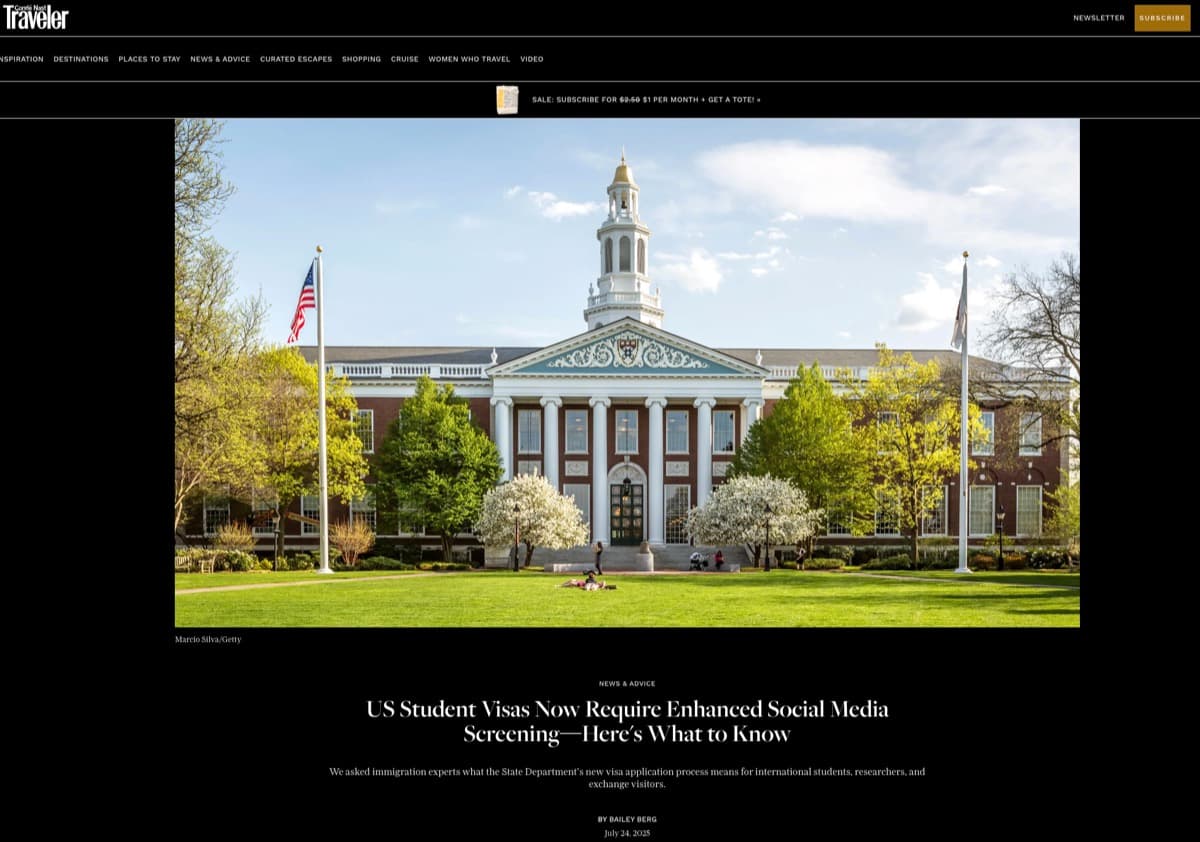
Condé Nast Traveler interviews Loren Locke about new social media screening requirements for student visa applicants.
From the Article
"Students need to understand that their digital footprint could become part of their permanent US immigration record."
"This means years of posts, comments, and friendships could be scrutinized."
"The routine student visa interview of years past no longer exists under these protocols."
"I am concerned about the chilling effect this new visa policy will have on legitimate academic discourse."
Locke Immigration Law's Take
The Condé Nast Traveler piece documents a specific operational shift that's now also extending to other visa categories: consular officers reviewing student visa applicants' social media history as a substantive part of the adjudication, not as a check-the-box procedural step. As Loren noted in the interview, "the routine student visa interview of years past no longer exists under these protocols." The interview format hasn't changed; the standard the officer is applying behind it has.
For students and their sponsoring institutions, the practical question is what counts as a problematic digital footprint. The screening isn't keyword-driven; the State Department's reviews focus on patterns suggesting affiliation with designated organizations, expressed support for activity that conflicts with US foreign policy, or content that contradicts the applicant's stated purpose for studying in the US. Loren's "chilling effect on legitimate academic discourse" concern is the policy-level objection — but the application-level reality is that political or social-media expression on certain topics now meaningfully shifts visa-approval probability.
Practical guidance we're giving applicants: assume your visible social media activity over the past five-plus years is part of the record. That doesn't mean scrub everything — adjudicators can also check the Wayback Machine, and a sudden mass-deletion is itself a flag. It means understanding what's discoverable, ensuring privacy settings reflect your intent, and being prepared to discuss anything substantive in the interview. For graduate students whose academic work touches on policy-sensitive topics, document that the work is academic and peer-reviewed, not advocacy. The vetting practice is here to stay, and it's spreading from F-1 to other visa categories.
Key Takeaways
- Social media screening is now a substantive part of student visa adjudication, not a procedural step — the interview format is the same, the standard behind it has shifted.
- Reviews target patterns: affiliation with designated organizations, expressed support for activity contrary to US foreign policy, content contradicting stated study purpose.
- Mass-deletion is itself a flag — adjudicators can check archived content. Better to manage privacy settings and prepare to discuss substantive posts than to scrub history.
- The vetting practice is spreading from F-1 to other visa categories; treat your social media history as part of your immigration record going forward.