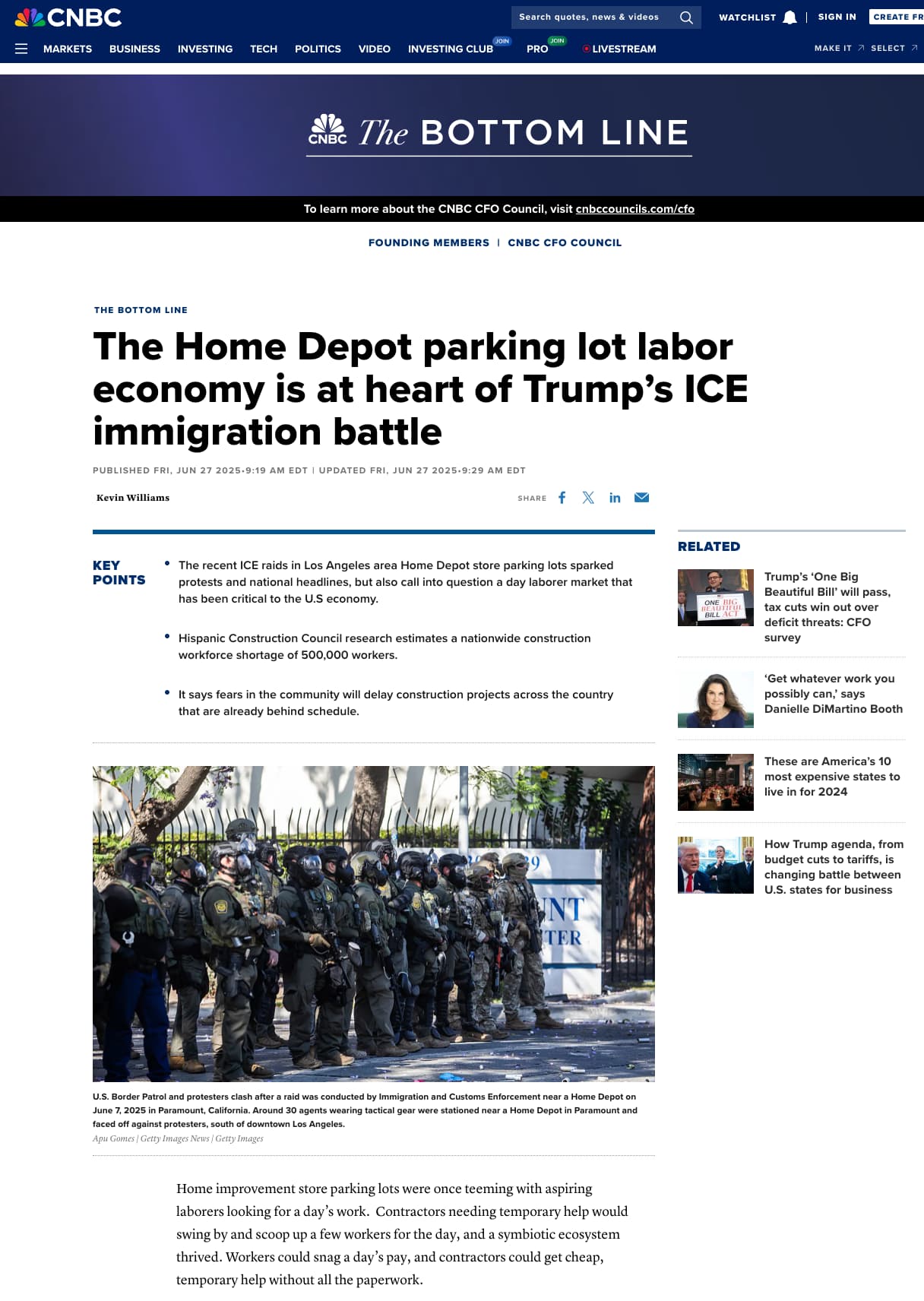
CNBC features Loren Locke discussing ICE enforcement operations in Home Depot parking lots.
From the Article
"Rather, they seem more like easy pickings for ICE to hit daily arrest quotas."
"We are in such a mess right now because there are millions of workers in the U.S. They were allowed in, and now we are going back to treating them like they are all unwanted."
Locke Immigration Law's Take
CNBC's coverage of the Home Depot parking-lot raids puts Loren's framing in the right macro context: "We are in such a mess right now because there are millions of workers in the U.S. They were allowed in, and now we are going back to treating them like they are all unwanted." That's the population-scale point most enforcement coverage misses. The workers visible at Home Depot pickup zones aren't a separate underclass; they overlap substantially with the same humanitarian-parole, TPS, and lawful-presence populations whose status was reclassified in earlier 2025 administrative actions. Many were authorized when they arrived. Authorization changed under them.
Loren's "easy pickings for ICE to hit daily arrest quotas" framing in the article points at the operational mechanism: when the political target is a 3,000-arrests-per-day rate (set by the White House in May 2025) and the historical population that supplied those numbers — recent border crossers — has shrunk because of declining border arrivals, the marginal arrest comes from concentrated, predictable, geographically reachable populations. Home Depot parking lots fit exactly that profile, regardless of any specific arrestee's authorization status.
For our employer-clients, the CNBC coverage adds a useful framing: the population at risk isn't only undocumented workers in the colloquial sense; it's also the "allowed in, now unwanted" middle ring — workers whose status was lawful, whose status was changed by reclassification, and who are now reachable in the same pickup zones, traffic stops, and workplaces where ICE operations concentrate. The compliance question for employers isn't "do we hire undocumented workers" (the answer should be no); it's "do we know which of our currently authorized workers sit in categories that may be reclassified in the next administrative cycle." That second question doesn't have a default answer at most employers, and it should.
Key Takeaways
- The "allowed in, now unwanted" population — workers whose authorization was changed by administrative reclassification, not workers who were never authorized — is at the center of current enforcement risk.
- The 3,000-arrests-per-day quota set in May 2025, paired with declining border crossings, mathematically forces enforcement toward concentrated, predictable, geographically reachable populations.
- Home Depot parking lots, traffic stops, and workplaces with predictable foreign-national worker concentration fit the marginal-arrest profile regardless of any specific arrestee's status.
- The compliance question for employers is no longer "do we hire undocumented workers" but "do we know which of our currently authorized workers sit in reclassification-vulnerable categories" — most employers don't yet have that map.