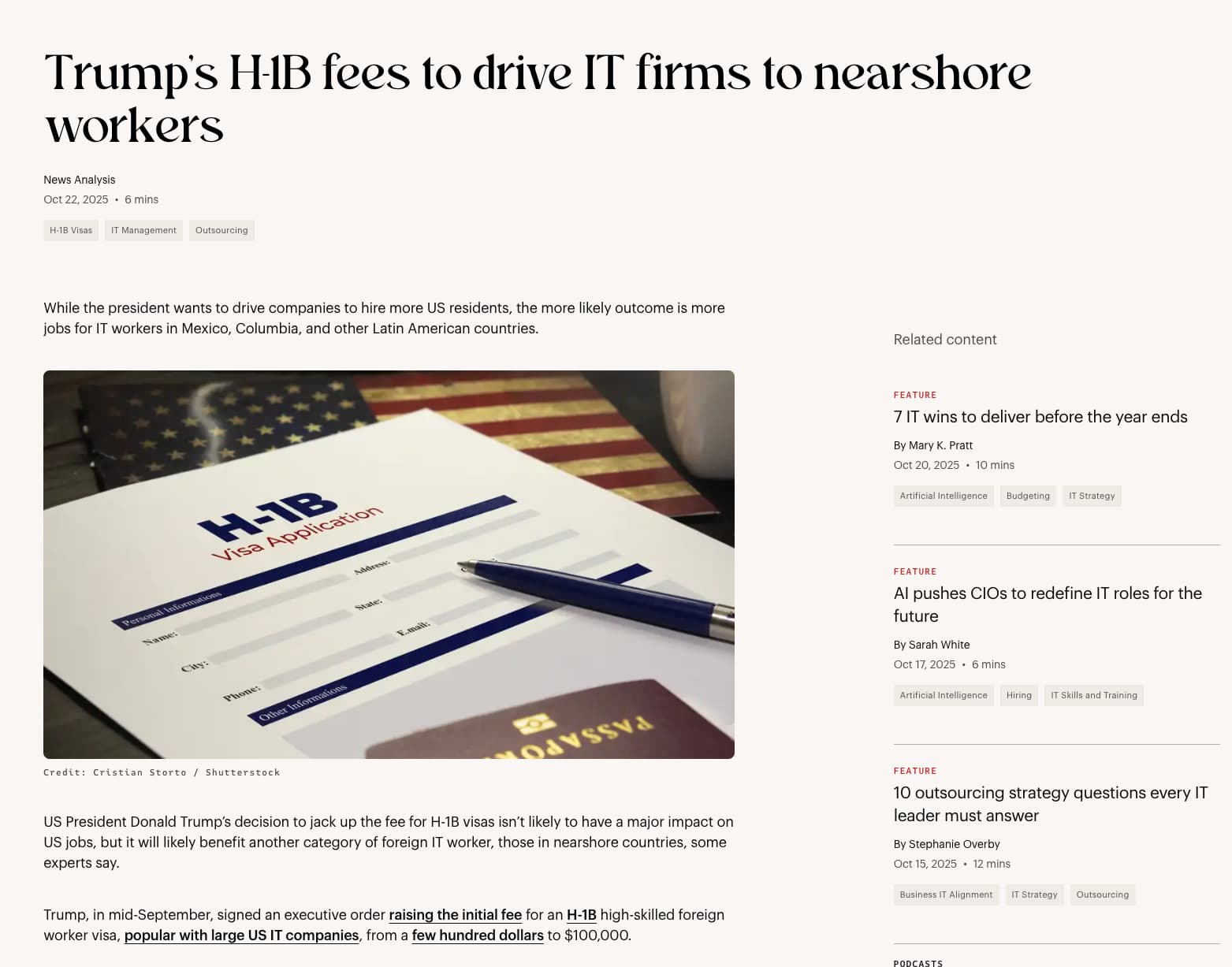
CIO quotes Loren Locke on the implications of Trump's proposed $100,000 H-1B visa fee for technology companies.
From the Article
"The $100,000 H-1B fee means companies will likely continue recruiting these students for OPT positions but then deploy them to nearshore offices in Canada or Mexico after their OPT expires rather than paying six figures to keep them in the US."
"We're essentially training top talent at American universities only to export them to compete against us."
"The $100,000 H-1B fee essentially creates a two-tiered system: Large multinationals have the flexibility to avoid the fee through nearshoring, while smaller employers lose access to international talent altogether."
Locke Immigration Law's Take
The CIO piece names the unintended consequence cleanly: a $100,000 H-1B fee designed to push companies toward US hiring will, for the firms with the operational infrastructure to do so, push hiring offshore instead. The article documents the predicted shift to nearshoring in Mexico, Colombia, and Costa Rica, and the OPT pipeline that becomes the bridge — recruit on F-1, train at a US university, deploy through OPT, then move the seat to a nearshore office when the OPT clock runs out. The fee doesn't change the demand for the talent. It changes where the company plants the chair.
The two-tier outcome Loren named in the article is the part that matters most for our small and mid-sized employer clients: large multinationals already have global capability centers and the tax-and-compliance machinery to nearshore at scale. Smaller employers, who don't, simply lose access to international talent. For those firms, the planning conversation we're having most often right now centers on alternative visa categories — O-1 for the genuinely top-of-field hires, EB-1A self-petition for employees with the profile to support it, E-3 and TN for citizens of qualifying countries, and L-1 where there's a foreign affiliate to work with.
What's still under-discussed: the OPT-to-nearshore transition the article describes is itself a planning event for the employee, not just the employer. STEM OPT runs three years; if the company's plan is to move the role abroad at month 25, the employee deserves to know — and has alternatives if the firm wants to retain them in the US, including parallel green-card filings while OPT is still active. We're seeing more H-1B-bound workers ask about EB-1A and NIW precisely because the H-1B route has gotten unreliable.
Key Takeaways
- The $100K H-1B fee creates a clear nearshoring incentive for any employer with cross-border operational capacity — the fee changes the seat location, not the talent demand.
- Two-tier outcome: multinationals adapt via global capability centers; small and mid-sized employers lose access to international talent altogether unless they pivot to alternative visa categories.
- The F-1 → OPT → nearshore pipeline turns the OPT period into a planning window, not just a work-authorization window. Employees deserve to know when their seat is being moved.
- Self-petition green-card pathways (EB-1A, NIW) are increasingly the practical answer for high-value workers whose H-1B path has become unreliable — and they don't depend on employer sponsorship.