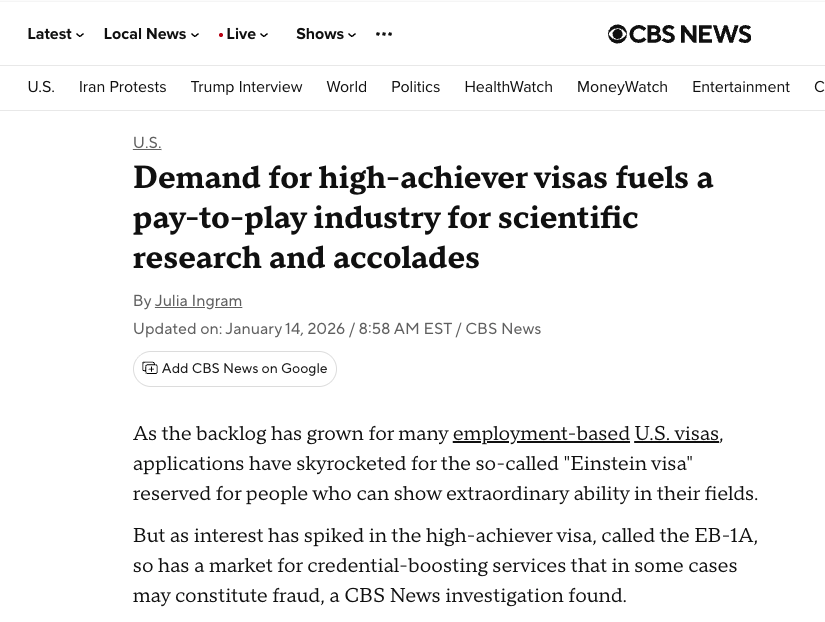
CBS News features Loren Locke discussing the rise of fraudulent credentials in EB-1A extraordinary ability petitions.
From the Article
"Having an attorney or career coach help you apply to legitimate opportunities that can raise an applicants' profile is not wrong. That line between what's appropriate like profile building, what's fair-game versus what's shady, it can be difficult to spot."
"They've been put in a situation just that's super untenable, which increases desperation, which increases risk taking."
Locke Immigration Law's Take
The CBS News investigation lands at a turning point in extraordinary-ability adjudication. USCIS has stood up a dedicated vetting center, characterized its posture as "declaring war on fraud," and signaled that already-approved EB-1A petitions may be reopened for retroactive review. For applicants and petitioners — including those who already hold approvals — this changes the risk calculation. A petition built on credentials that look manufactured is no longer just a current-filing problem; it can become a status problem years later.
Loren's point in the article — that the line between legitimate profile-building and "shady" credential manufacturing can be difficult to spot — is exactly why we audit incoming cases against the specific patterns USCIS is now flagging, rather than against intuition. The mechanisms reporters and adjudicators are tracking are concrete: paid authorship slots on ghostwritten research, citation-stacking services, awards from organizations whose only filter is a fee, and "peer-reviewed" publications whose actual review consists of a turnaround promise. Each of these leaves traces a careful adjudicator can follow.
The strongest petitions look different in ways adjudicators can verify: scholarly work in journals indexed by MEDLINE, Scopus, or the Journal Citation Reports; citation counts traceable through Google Scholar or Web of Science; awards with a documented selection committee and a review record; judging service for peer-reviewed conferences or named editorial boards; financial outcomes or industry adoption attributable to the applicant's own contributions. Where a profile genuinely doesn't yet meet that bar, the disciplined path is a different visa category or a longer runway — not a creative drafting problem.
Key Takeaways
- USCIS launched a dedicated EB-1A vetting center and has signaled possible retroactive review of already-approved petitions.
- The credential-manufacturing market named in the reporting includes paid authorship slots, citation-stacking, vanity awards, and predatory-journal "peer review."
- A petition built on borderline evidence puts the entire case at credibility risk — and now puts existing status at risk too.
- The adjudicator-resistant version of every EB-1A criterion has a verification trail: indexed publications, traceable citations, documented selection processes, named review panels.