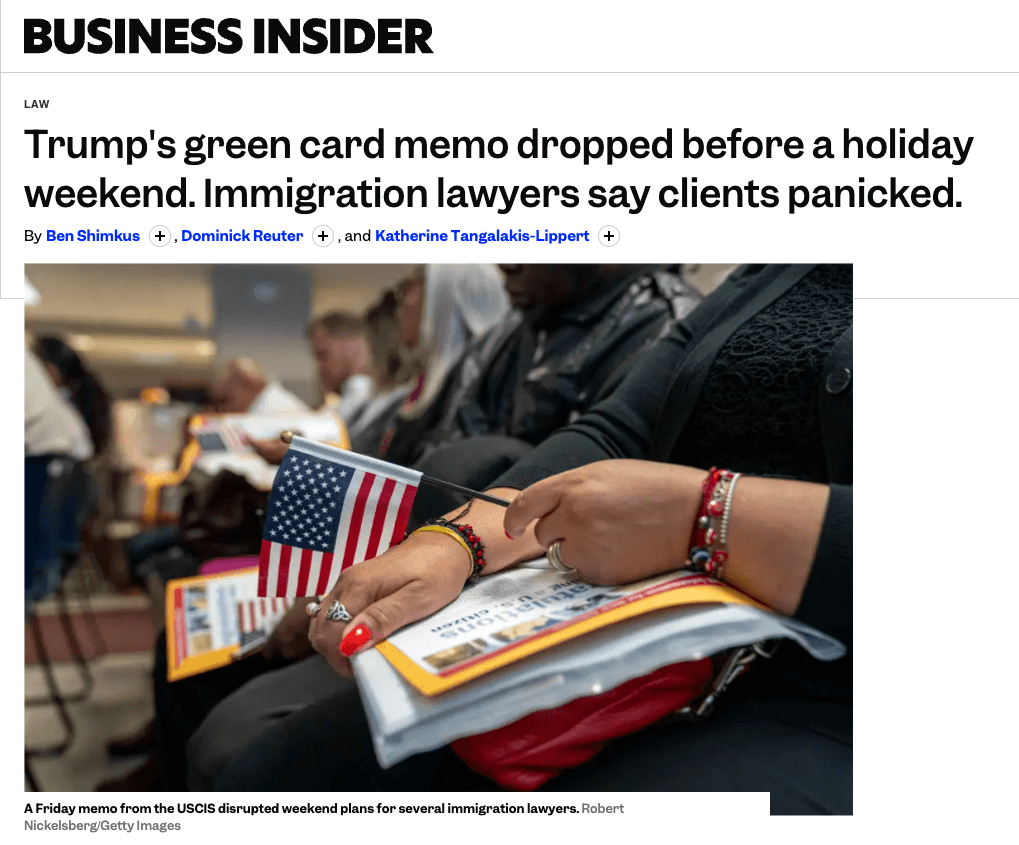
A Friday USCIS memo restricting in-country green-card processing dropped right before Memorial Day weekend — Loren Locke tells Business Insider she started hearing from anxious clients within minutes.
From the Article
"I started hearing from my clients and from other immigration attorneys within minutes of this memo dropping on Friday morning. It has thrown a lot of uncertainty into something that's been very stable and very predictable for decades, out of nowhere, with no warning."
"It has been chaotic. Right now, we are waiting to see what USCIS does."
Locke Immigration Law's Take
Adjustment of status — the in-country green-card completion step that lets a worker already in valid US status (H-1B, O-1, L-1) convert to a green card without leaving for consular processing — has been the default end-of-the-line move on employment-based cases for two decades. The Friday memo Business Insider reports on restricts AOS to "extraordinary circumstances" without defining the term. Loren's "out of nowhere, with no warning" framing captures both the policy substance and the operational shock: a memo dropped late Friday into a holiday weekend, when sponsoring employers cannot reach the agency and applicants cannot reach their lawyers.
The USCIS spokesperson's carve-out in the article — applications that "provide an economic benefit or otherwise are in the national interest" — describes almost verbatim the categories that make up our day-to-day filing book: EB-1A extraordinary ability, EB-2 national interest waiver, employer-sponsored EB-2 and EB-3, EB-1B outstanding researcher, EB-1C multinational manager. If the carve-out holds in implementing guidance, the typical case profile in this practice is structurally insulated. The article's own comparison is the right one to keep in mind: in September, the presidential proclamation raising the H-1B petition fee to $100,000 sparked similar alarm before later guidance softened its apparent impact. Until USCIS publishes implementing guidance or processes a batch of I-485s under the new framework, the actual scope of "extraordinary circumstances" is unknown.
The disciplined response right now is the one Loren named: wait to see what USCIS does. Three practical points for clients in the meantime. (1) Don't withdraw a pending I-485 or pre-emptively convert it to consular processing; adjudication continues, and nothing in the memo retroactively unwinds filed AOS cases. (2) For cases not yet filed, the question is which side of the carve-out the applicant sits on — employment-based skilled categories the USCIS spokesperson described should keep filing on schedule; categories outside that lane warrant a conversation about timing. (3) For employers, the cost of a knee-jerk reaction is asymmetric. Sending a senior international hire abroad for consular processing because of one Friday-night memo can pull them out of the country for months at a moment of strategic value to the company. The downside of waiting two weeks for clarity is small. The downside of moving first and being wrong is large.
Key Takeaways
- The Friday USCIS memo restricts "adjustment of status" — the in-country green-card pathway used by most employment-based workers in valid US status — to "extraordinary circumstances," with no definition of the term in the memo.
- A USCIS spokesperson said the change likely won't impact applications that "provide an economic benefit or otherwise are in the national interest" — language that maps onto EB-1A, NIW, and employer-sponsored EB-2/EB-3 categories, but only holds if implementing guidance preserves it.
- Lawyers in the article compared the rollout to the September presidential proclamation raising the H-1B fee to $100,000 — initial alarm, later softened by guidance. Wait for USCIS to publish implementing guidance before changing course.
- The right move now is to hold pending I-485s steady, not pre-emptively convert to consular processing. The cost of forcing a worker out of the US mid-green-card is materially worse than the cost of waiting two weeks for clarity.