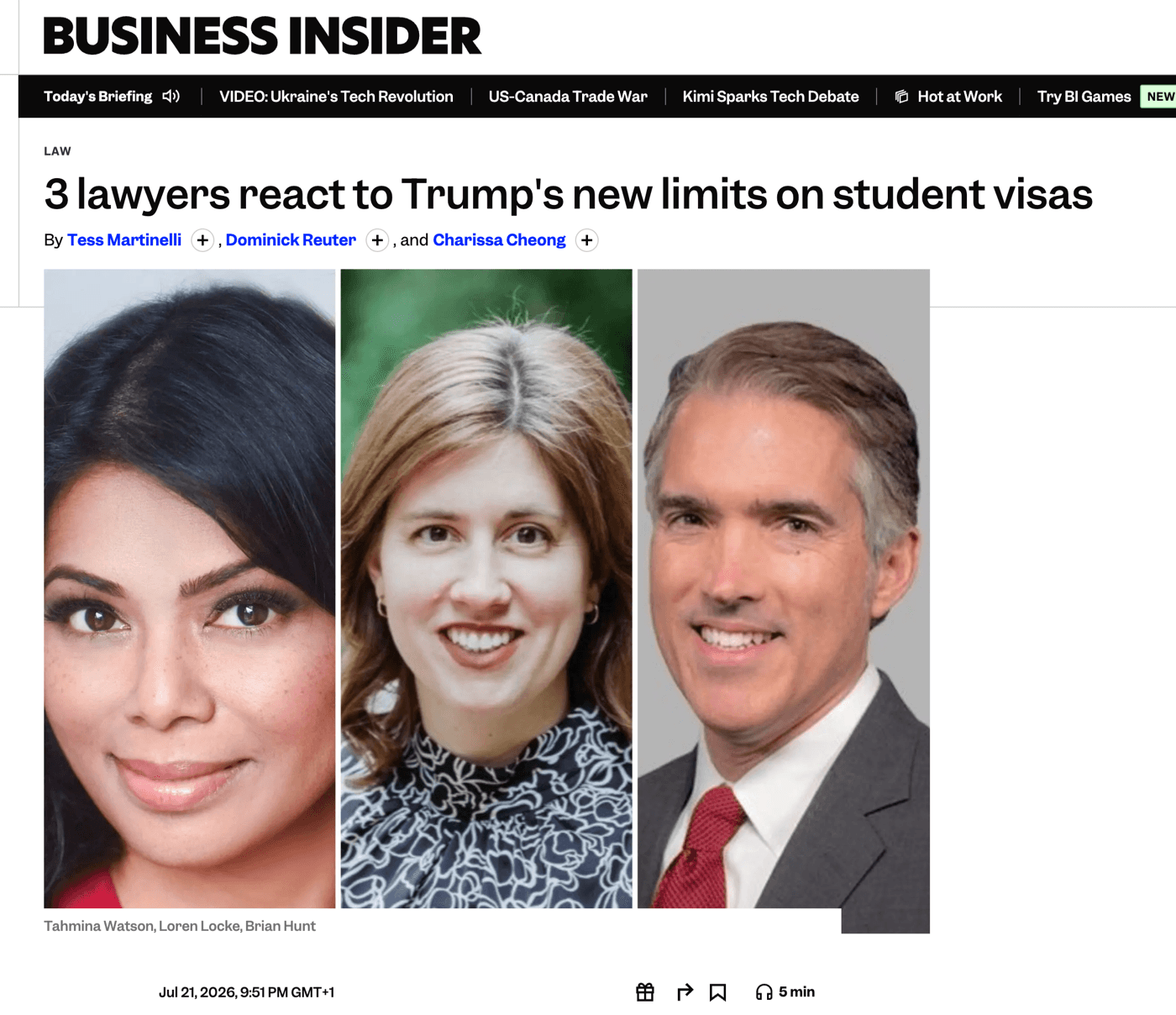
DHS would cap F-1 status at four years and cut the post-graduation grace period from 60 days to 30. Loren Locke, a former U.S. consular officer, tells Business Insider that “a one-size-fits-all duration won't fit many students' degree programs” — fewer than half of American undergraduates finish a bachelor's degree in four years, and engineering, architecture, doctoral, and medical programs routinely run longer.
From the Article
"Fewer than half of American undergraduates finish a bachelor's degree within four years. The Department of Education doesn't even use four-year completion as its official measure, and instead reports six-year rates. Many engineering and architecture programs are designed to run five years. Doctoral programs and medical training routinely last longer than five years. A one-size-fits-all duration won't fit many students' degree programs, not to mention how many will be impeded from completing post-graduate employment that international students have long been eligible for."
"As a lawyer, it worries me that USCIS could arbitrarily deny extension applications or take so long that the student's course of study is effectively ruined, and there would be no recourse that would allow the student to get back on track."
"Barely a year and a half ago, DHS codified a deference policy promising consistency for people the government had already approved. This rule strips that protection from students."
"The United States invites students from around the world to pay full freight at our universities. Holding over them the very real and increasing risk that they will walk away without a diploma, despite doing everything right, really damages our brand as a good destination for international students. This will have a tremendously bad economic impact."
Locke Immigration Law's Take
The rule's defect is arithmetic before it is legal. Duration of status exists because academic programs do not run on a fixed clock, and Loren's numbers are the whole argument: fewer than half of American undergraduates finish a bachelor's in four years, the Department of Education itself reports six-year completion rates, and five-year engineering and architecture programs, doctoral study, and medical training are ordinary rather than exceptional. A four-year cap does not shorten those programs. It converts the back half of a normal degree into a discretionary application, and it does so for the students who were never the stated problem — the ones enrolled, in status, and paying full tuition.
The consequence Loren flags as a lawyer is the one worth planning around: what happens when the extension is filed and nothing comes back. A denial is at least a decision. Silence, on a case where the government has already approved the underlying status, is what strands a student mid-program with no way to get back on track. Her point about the deference policy sharpens this — DHS spent 2024 codifying the principle that a prior approval should mean something on the next filing, and this rule carves students out of it. That is a meaningful change in posture toward exactly the population that has historically fed the skilled-worker pipeline, and it lands first on the F-1-to-OPT-to-H-1B sequence employers have quietly built hiring plans around.
For students and the companies that intend to hire them, the practical response is to compress timelines wherever the law allows and to stop treating status as something to revisit at graduation. File OPT and STEM OPT at the first eligible date rather than the last. Assume a shorter post-completion grace period and a longer government processing tail, and build travel plans on the assumption that leaving is easier than returning. And for the strongest candidates — researchers, engineers, physicians finishing training — the conversation about a self-petitioned EB-1A or EB-2 National Interest Waiver, or an employer-backed path, should start years earlier than it used to. The durable protection against a rule like this is not a better extension filing; it is a status that does not need renewing on someone else's schedule.
Key Takeaways
- The finalized DHS rule would replace F-1 "duration of status" with a four-year cap, cut the post-graduation grace period from 60 days to 30, and bar starting another program at the same or a lower academic level. If it clears congressional review it takes effect September 15, 2026.
- Loren's core objection is that the cap does not match how degrees actually work: fewer than half of U.S. undergraduates finish in four years, the Department of Education measures six-year completion, and engineering, architecture, doctoral, and medical programs routinely run longer than five.
- The litigation-free failure mode is delay, not denial — USCIS could sit on an extension long enough to ruin a course of study, with no recourse. The rule also strips students of the DHS deference policy codified barely 18 months earlier for previously approved filings.
- The exposure runs into the employment pipeline: F-1 → OPT/STEM OPT → H-1B is how many U.S. employers source technical talent, so students should file OPT at the earliest eligible date and strong candidates should open the EB-1A / EB-2 NIW conversation well before graduation.