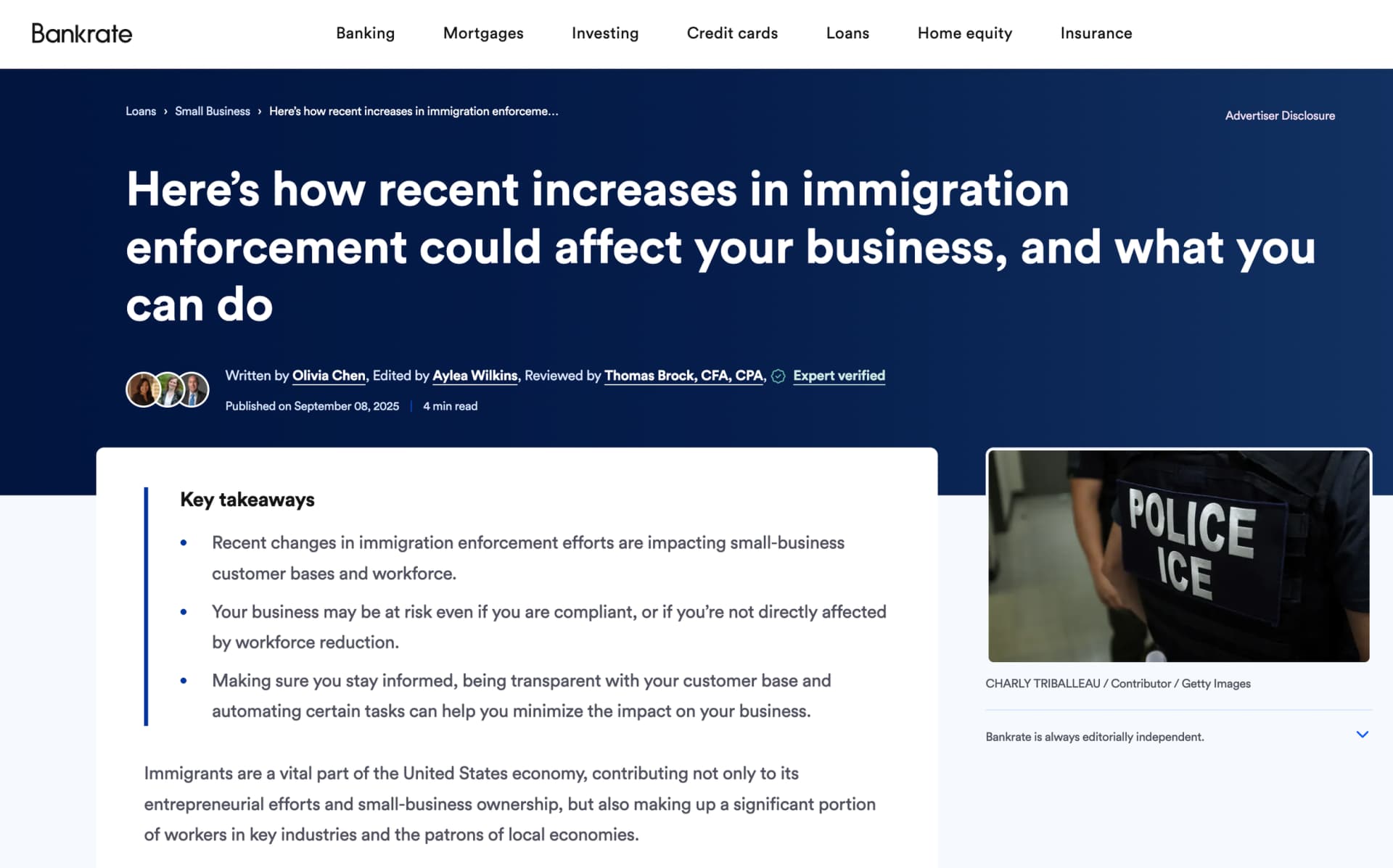
Bankrate features Loren Locke discussing the business impact of heightened immigration enforcement.
From the Article
"You can't really afford to lose them all at once. People could die."
"Recent and sweeping re-classifications of humanitarian benefits like temporary protected status (TPS) are leading to overnight changes in the legal statuses of individuals, and consequently massive workforce disruptions for certain small businesses."
Locke Immigration Law's Take
The Bankrate piece sharpens a distinction that often gets lost in immigration-enforcement coverage: the workers most at risk are not undocumented. They are TPS holders, parolees, and others whose status is being revoked or allowed to expire by administrative reclassification. DHS moved to end Haiti's TPS designation as early as August 3, 2025, but a federal court (Judge Brian Cogan, E.D.N.Y., July 1, 2025) blocked that early termination and restored February 3, 2026 as the designation's end date; nearly 700,000 TPS holders across the named countries face expiration risk; over half of the 15 qualifying countries have TPS set to expire by year-end. These are workers who came to the United States lawfully and have been working under valid authorization for years. The reclassification removes that authorization on a calendar.
The nursing-home example is the article's sharpest detail and the reason Loren's "people could die" quote lands. A facility that built its staffing model around Haitian TPS workers and loses authorization for that population on a single date isn't just facing a labor shortage — it's facing immediate care-quality and regulatory risk. The same dynamic shows up in agriculture, hospitality, and any small business whose workforce concentration matches a specific TPS-eligible nationality.
For business clients, the planning conversation we're having now starts with a workforce audit: which roles are filled by TPS, parole, or other status-conditional workers, and what are the per-employee dates? Then it moves to alternatives: PERM-based green-card sponsorship for the long-tenured employees the business genuinely needs to retain, H-1B or O-1 if the role qualifies, and contingency staffing models for the cases where the worker can't be retained on a different pathway. Waiting for the deadline before opening these conversations is the planning failure most likely to produce the catastrophic outcome the article describes — losing the workforce overnight rather than transitioning over months.
Key Takeaways
- The most acute workforce risk isn't undocumented workers — it's TPS holders, parolees, and similar lawful-but-status-conditional workers losing authorization by administrative reclassification.
- DHS tried to end Haiti's TPS as early as August 3, 2025, but a federal court blocked the early termination and restored February 3, 2026; ~700,000 TPS holders across qualifying countries face expiration, with over half of the 15 designated countries set to expire by year-end.
- Industries with high concentration of TPS-eligible workforces (nursing homes, agriculture, hospitality) face overnight staffing collapse, not gradual attrition.
- Employer planning starts with a workforce audit by status type and per-employee expiration date — most businesses don't yet have this map.
- Long-tenured workers can often be retained via PERM-based green-card sponsorship, H-1B, or O-1; waiting for the TPS deadline forecloses these pathways.