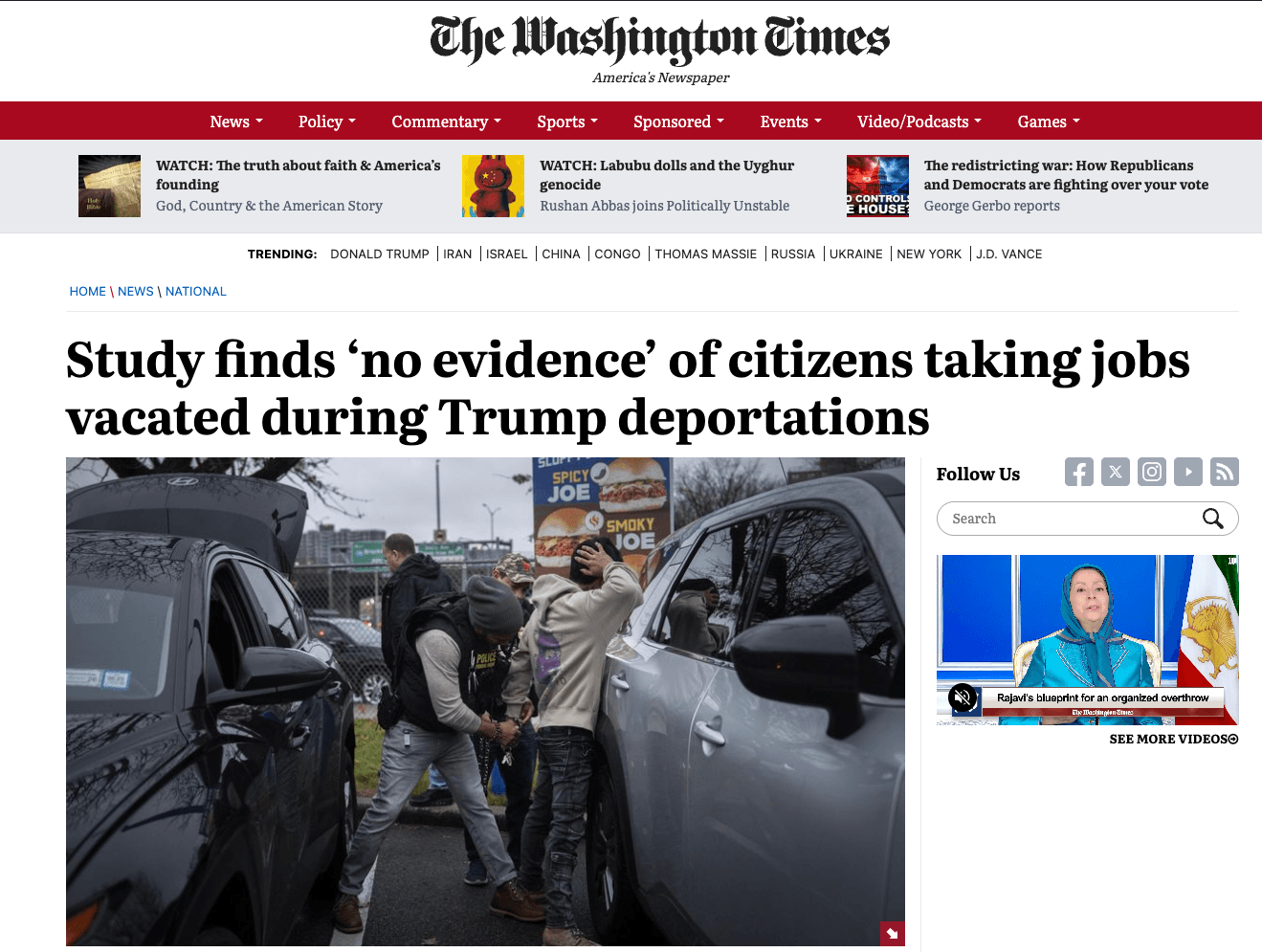
A University of Colorado Boulder study found U.S.-born workers didn't fill jobs left by deported immigrants — Loren Locke tells The Washington Times the real fix is an employment-based visa system Congress hasn't updated in decades.
From the Article
"We have employment-based visa categories that haven't been meaningfully updated in decades, and the result is a permanent shadow workforce that enforcement actions can disrupt but can't replace."
Locke Immigration Law's Take
The study The Washington Times reports on punctures a popular assumption — that removing undocumented workers transfers their jobs to citizens. The University of Colorado Boulder economists found the opposite: as likely-undocumented employment in agriculture, construction, and manufacturing fell 4%, U.S.-born men with a high-school education or less in those same industries fell 1.3%. The jobs didn't change hands. They were automated, eliminated, or left unfilled. Loren's contribution to the piece names why: there was no legal channel through which that workforce could be replaced.
The phrase Loren uses — a "permanent shadow workforce" that enforcement "can disrupt but can't replace" — is a precise description of a structural gap, not a rhetorical flourish. For year-round, lower-wage work in these industries, the legal options are narrow: H-2A and H-2B visas are capped and built for seasonal need, and no visa category exists for year-round work of this kind at all. Enforcement subtracts from the shadow workforce; nothing in current law adds back. That is why the workforce is "permanent" — it reconstitutes because the underlying demand has nowhere legal to go.
The diagnosis Loren offers — "employment-based visa categories that haven't been meaningfully updated in decades" — is not confined to low-wage labor. It is the same constraint we navigate every day on the skilled side of the system: an H-1B cap fixed at 85,000 since 2004, and employment-based green-card backlogs that run decades for applicants from some countries. The practical lesson for employers is consistent across the wage spectrum: do not build a workforce plan on a category Congress has frozen. Where roles can be filled through categories that still function — O-1, EB-1A, TN, L-1 — that is where planning should concentrate, and matching roles to the categories that actually clear is work employers can do now, regardless of what Congress does.
Key Takeaways
- A University of Colorado Boulder study (economists Chloe East and Elizabeth Cox) compared ICE arrest data with federal labor statistics from October 2023 to October 2025 and found no evidence citizens filled jobs vacated during deportations.
- As likely-undocumented workers in agriculture, construction, and manufacturing declined 4%, U.S.-born men with a high-school education or less in those same industries declined 1.3% — employers automated or eliminated roles rather than hiring citizens.
- Loren Locke's diagnosis: a "permanent shadow workforce" exists because employment-based visa categories haven't been meaningfully updated in decades — enforcement can remove workers, but no legal channel exists to replace them.
- The same structural lag governs skilled immigration — an H-1B cap frozen at 85,000 since 2004 and decades-long green-card backlogs; employers should build workforce plans around categories that still function, not ones Congress has frozen.