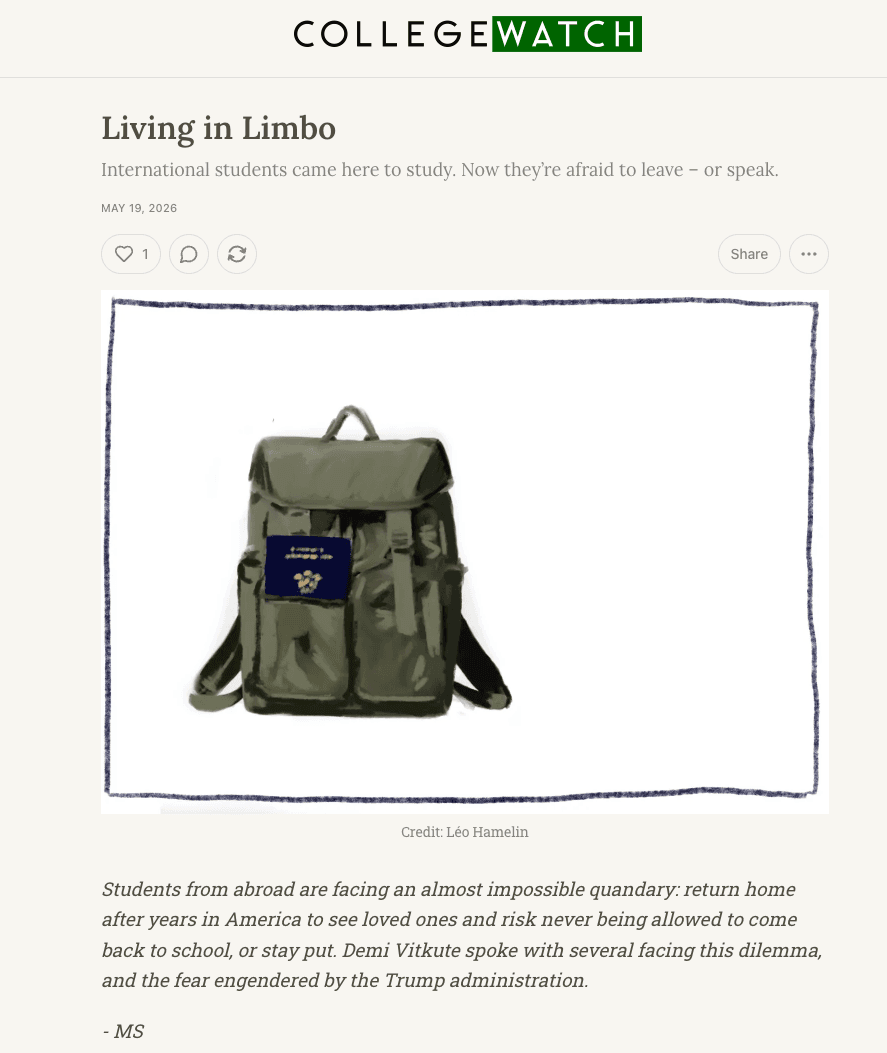
Loren Locke tells CollegeWatch why she advises international students against summer travel — the visa they need to return is now adjudicated under a very different regime than the one that let them in.
From the Article
"For the past year, my consistent advice to international students has been the same: if you don't have to leave the U.S. this summer, don't, because the visa you need to come back is now adjudicated under a very different regime than the one that got you here."
"Students from China and Iran have long faced heavier Technology Alert List scrutiny in STEM fields, and that has intensified. Indian students are caught in the green card backlog trap — they may transition successfully to H-1B but still face a lifetime of visa-stamping anxiety. Students from visa-waiver countries in Europe generally have smoother experiences but are not immune, especially if they've been visibly involved in campus political activity."
"There is no clear timeline or plan for visa adjudication to return to normal capacity, especially as the State Department just had an unprecedented massive layoff of Foreign Service Officers. Students should book their interview as far in advance as possible, and current international students should carefully evaluate any international travel that would require them to apply for a new visa."
Locke Immigration Law's Take
The trap Loren describes in the CollegeWatch piece turns on a distinction most students don't internalize until it's too late: a valid visa stamp and valid status are two different things. A student in good F-1 status is generally fine to stay in the U.S. on an expired visa stamp. The risk only crystallizes at the consulate — the moment they leave and need a fresh stamp to get back. As Loren puts it, the visa you need to return is "adjudicated under a very different regime than the one that got you here." The trip home isn't the gamble; the reentry is.
Loren's second point — that the risk isn't uniform — is the one that should drive individual decisions. A European student from a visa-waiver country with no campus political profile faces a very different calculus than a Chinese or Iranian STEM student subject to intensified Technology Alert List review, or an Indian student already living with the green-card backlog. Layer on the State Department's unprecedented Foreign Service Officer layoffs, and even a routine renewal can strand a student abroad for months with no firm timeline. The practical takeaways are concrete: book the interview as far ahead as possible, and treat any travel that forces a new visa application as a decision to plan around, not a formality.
The deeper fix — and the conversation we have with students who can have it — is reducing how often their life depends on a consular officer at all. Visa-stamping anxiety is structural: every renewal is another adjudication. For students with the right profile, the planning question is whether to move toward more durable status sooner — H-1B and an employment-based green card, or self-petition categories like EB-1A and the EB-2 National Interest Waiver for the strongest cases. None of that is a quick fix, and none of it changes this summer's math. But it changes how many times, over a career, someone has to hold their breath at a U.S. consulate.
Key Takeaways
- Valid status and a valid visa stamp are different things — a student in good F-1 status can stay on an expired stamp; the risk appears only when they leave and need a new one to reenter.
- Reentry risk is not uniform: China/Iran STEM students face intensified Technology Alert List scrutiny, Indian students the green-card backlog, and even visa-waiver-country students aren't immune if they've been politically visible on campus.
- State Department Foreign Service Officer layoffs mean no reliable timeline for visa adjudication — book interviews far in advance and plan around any travel that requires a new visa.
- The structural fix is reducing dependence on repeat visa stamping: students who qualify should weigh moving toward more durable status (H-1B to a green card, or EB-1A / NIW self-petition) sooner rather than later.